
By Peter Richards
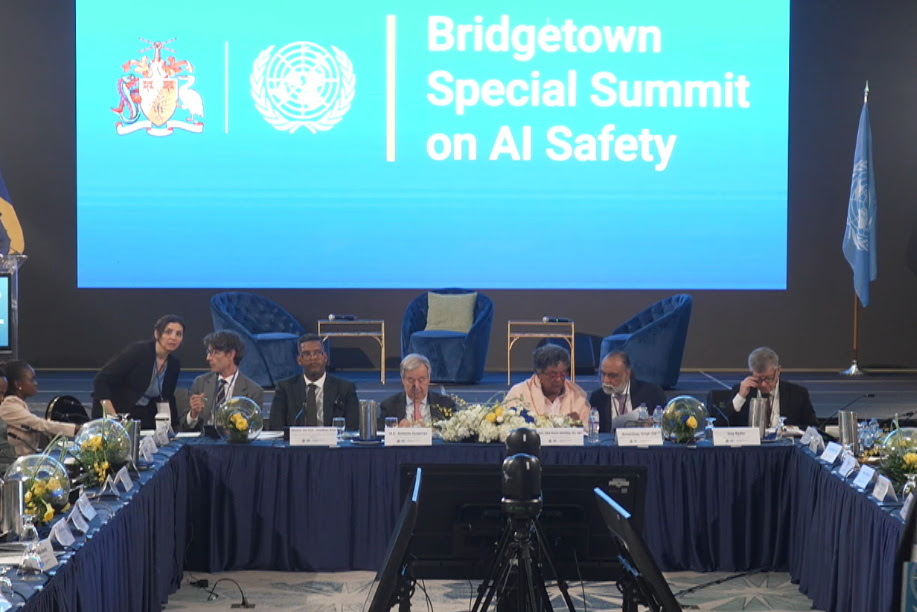
BRIDGETOWN, Barbados, Nov 23, CMC – The inaugural Bridgetown Special Summit on AI Safety ended here on Monday amid optimism that efforts are being made towards a global governance system that will govern artificial intelligence (AI).
“It’s essential, essential to guarantee that these gigantic developments we are witnessing at an enormous speed of artificial intelligence are subject to effective oversight and are brought under control to make sure that human agency prevails,” United Nations Secretary-General Antonio Guterres told a news conference at the end of the one-day event that had been hosted by the Barbados government and the UN.
“I am convinced that the public opinion in the world is more and more aware of the urgency of doing something serious for that oversight to be put in place, and I believe the UN can give an important contribution for that,” Guterres said at the end of the event that brought together hundreds of delegates, including government leaders and stakeholders to advance international cooperation on AI safety.
Guterres said that the urgency is obvious when some of the developers of these technologies are themselves saying that it might be dangerous for humanity.
“It is absolutely crucial, first of all, to make sure that we don’t move too fast, second that whatever we do when moving is subject to an oversight that guarantees the safety of what is done,” he added.
Barbados Prime Minister Mia Mottley told reporters that human beings will either act on the brink of disaster or post-disaster and that she is hoping that after the last century “where we acted after disaster that we have now sufficient commitment and common sense to act before the disaster”.
She said that the thematic brief from the UN independent scientific panel presented at the event “should be sufficient to move every global leader to urgent action.
“There may be those who currently have a distinct advantage, but beyond those two countries that have that distinct advantage, the other 191 face the possibility of subjugation effectively. “We in this region know what it is to have been forced to come here, forced to work and to have our dignity taken from us. In other words, Barbados knows it even more because the 1661 slave code became the first legislation globally to commoditise human beings and to treat them as chattel.
“That is the reason why we offered to host this conference here because in our opinion the world must never again see the subjugation or commoditisation of human beings and I pray that the mere possibility of that combined with the deepening global inequity both in terms of power as well as resources will cause countries across the world to find common purpose in acting together and bringing that sense of necessary regulation,” Mottley said.
She said she was heartened to hear the Chinese ambassador attending the conference “reflect on the fact that President Xi is committed to a global governance for AI and I hope that we can get that commitment from every single country in this world because it is critical and time is not waiting on any of us”.
Monday’s event brought together stakeholders from governments, tech, science, civil society, and the UN under the core themes that focus on global AI safety cooperation, risk management, equitable access, capacity building, and cultural/linguistic representation.
The UN said that the summit serves as a collaborative platform without establishing binding global rules, enforcing a single governance framework, superseding national policies, or dictating the scientific agenda of the Independent International Scientific Panel on AI.
Guterres told the news conference that “we have just concluded an important gathering on AI safety and inclusivity,” noting that he is prepared to address the questions “Why now? Why here? And what next? “
He said artificial intelligence is advancing at extraordinary speed, transforming how people work, learn and communicate.
“It’s opening new possibilities in health, education, science and development. And it has the potential to accelerate progress on some of the greatest challenges we face. But as AI becomes more powerful and more widespread, the risks are also becoming clearer.”
Guterres said that recent technological outages and cyberattacks have exposed vulnerabilities of the digital systems on which many increasingly depend, adding, “AI is amplifying the threats.
“We are seeing new cybersecurity risks, new possibilities for manipulation and misuse, and systems behaving in ways that even their developers did not always anticipate. Some of those at the forefront of developing artificial intelligence are themselves sounding the alarm about the increasingly powerful systems.
“We have a responsibility to take those warnings seriously. Not to stop innovation or spread fear, but to ensure that our capacity to manage this technology keeps pace with the technology itself. We don’t have a moment to lose. The situation is a situation of urgency.”
Guterres said that bringing the conversation to Barbados sent an important message.
“The future of AI cannot be decided by a few for everyone else. AI is already reaching into every economy and every society. But many countries still lack the tools, knowledge, and capacity to assess the systems entering their markets, manage the risks, and protect their people when problems arise.
“That gap must be closed. Every country must have the capacity to manage AI safety. Every country must have a voice in shaping its future. And ultimately, stronger international cooperation will help every country strengthen their own protections,” Guterres said, adding that Bridgetown is a fitting place to advance that work.
He told reporters that throughout the discussions on Monday, “our message came through loud and clear.
“Protections remain fragmented, and too often they are playing catch up. We need a shared understanding of emerging risks, credible and independent ways to evaluate powerful AI systems, and greater transparency when serious incidents or near-misses occur so countries can learn from one another rather than confront the same dangers alone.
“That is why today I call for Member States to coordinate efforts and to develop within the next year a globally inclusive and principles-based multilateral framework for AI risk management backed by independent and credible oversight.”
Guterres said that discussions could start with the functions and mechanisms for practical multilateral cooperation with full representation of all countries and stakeholders.
“We also urge States, as well as the private sector, financial institutions, foundations, and other donors in a position to do so, to increase investments in AI capacity building and contribute urgently to funding for developing a minimum AI capacity in regions in the Global South.”
He said that could be an early commitment to the three billion US dollar Global Fund for AI Capacity Building proposed by the UN General Assembly.
“Put simply, we need a common foundation for AI safety, shared safety measures, common approaches to testing, safeguards and standards, and basic requirements for transparency, independent evaluation and oversight of advanced AI models, and support to ensure that every country has the tools, knowledge, and capacity to put these measures into practice.
“As this technology develops and spreads, safety must come first, and the way forward must include all countries. The risks are global; our response must be global, that is why we must act now,” Guterres added.
Mottley said that AI holds immense potential for the benefit of all humanity and that every country should have the opportunity “to build, test, and use AI on its core interests.
“National cooperation and regional solidarity are crucial to realise this goal, as is strong domestic and regional regulation. If capacity to build and run AI remains concentrated in a few regions, existing inequalities would widen further.”
She said urgent investments are therefore necessary to build AI capacity in all regions of the world.
“Infrastructure, data sets, skills, models that respect local values and priorities, and indeed, that which is necessary to prepare our workforce. AI innovation must advance human rights, must support sustainable development, and must enable all people to have agency over their future, including AI that reflects the world’s diversity
“We do not want to see the commoditisation of human beings again as data packs just for the interests of a few who stand to make extraordinary profits,” she said, adding that “concrete AI projects to protect cultural and historical heritage and to promote diversity could be a practical demonstration.”
Mottley said that AI risks do not respect borders and that national and international AI risk management efforts, therefore, must reinforce one another to ensure that the development, deployment, and use of AI are safe, that it respects human rights and human agency, and that it effectively remains under human control.
“Humans must control AI. AI must not control humans. At the Bridgetown Special Summit today on AI Safety, we heard further appeals for action on, one, AI safety and risk management, including international cooperation on accountability, liability, most importantly, insurance arrangements, and enforcement equally important for harms from AI systems.”
She said building safety into procurement requirements, “as we discussed, ensuring that perhaps a kill switch is available from the point of purchase, as opposed to an afterthought.”
Mottley said that there are many plans to stage AI conferences across the globe and we also heard a strong sense of urgency for the need for collaboration between these efforts, and to develop plans for new institutional arrangements in the next six to 18 months.
“In my own personal view, 18 is far, and we need to work faster and quicker,” she said, adding that the United Nations exists because it is the one place that “assures us of fairness and safety.
“And while we welcome all of these other summits, including our own here, we need to commit to a central global governance framework,” Mottley told reporters.
CMC/pr/ir/2026