
By Staff Writer
ST. JOHN’S, Antigua, Nov 2, CMC – Australia Monday urged the Commonwealth to help regulate the digital world, which it says has become a crucial issue of national sovereignty and democracy.
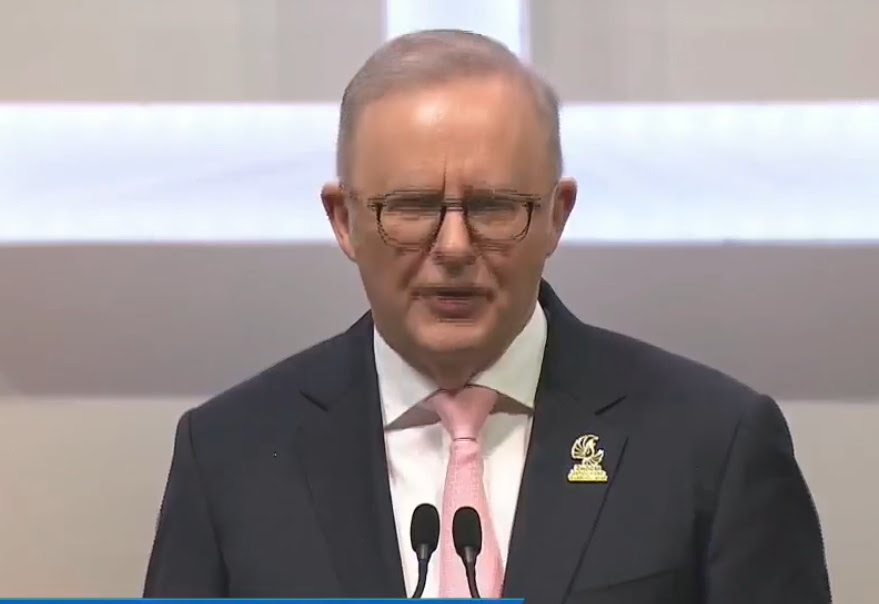
Addressing the opening of the Business, Women, Youth and People Forums of the Commonwealth Heads of Government Meeting (CHOGM), Australian Prime Minister Anthony Albanese said his country is investing more than ever in new partnerships to support economic resilience, grow the private sector and trade, improve maritime security, advance climate action, and guide the safe adoption of emerging technologies.
“We support the principle that humans must stay in control over the development and deployment of artificial intelligence. The potential of artificial intelligence to help unlock scientific breakthroughs, raise living standards and improve the way people work and do business is significant.”
Albanese said that AI is a reality which is here to stay, “but we can choose to shape it or let it shape us.
“Being created by humans, AI must be controlled by humans for the benefit of humanity. That is why Australia understands that for many member countries, climate change is an existential threat.
“We need to make sure whether it’s the challenge of AI or the challenge of climate change, we work together as a Commonwealth,” Albanese said, recalling the statement made by Britain’s King Charles that the task before the world is not merely to advance technology but to ensure that it remains firmly in the service of humanity, community and the natural world.
He said King Charles had also asked whether a shared set of principles could be developed to help the future application of AI for human benefit.
“I certainly agree, and Australia has been an early mover in this field, setting clear expectations on the role that technologies play in our lives and expectations on companies providing them to us.
“These include our social media minimum age, which places the onus on platforms, not parents, to ensure that under-16s are not accessing them and giving children back their childhoods.”
Albanese said that the Commonwealth is a young people-dominated entity and, as a result, it must protect its young people.
“Our digital duty of care legislation, which is currently before our Parliament, also places the onus upon tech companies to ensure their products and services are safe for individuals and society.”
He said that the development of AI standards, which must be done not just at a national level but at a multinational level as well, will be important.
“We know that algorithms can contribute to increasing anger, increased division, misogyny and violence in our societies and that rogue nations are using disinformation and misinformation across national boundaries and interfere in elections.
“Regulating the digital world has become a crucial issue of national sovereignty and democracy, and it will be an important part of discussion here by Commonwealth nations over the coming days,” Albanese said, adding “we sincerely hope that we can work together to make sure that humans continue to direct how this new technology is rolled out and what it is used for”.
The Australian prime minister said that climate change is also an issue that requires the Commonwealth to work together.
“We all have strong domestic emissions targets. Australians are ambitious but achievable. We’re modernising our energy system, and we’ve become world leaders in home battery installation.
“But indeed we know that we have a role to play on the world stage too. Our Pacific family, like Caribbean nations, are at the front of the challenge of climate change. So we’re backing also Pacific-led solutions in our region, including the Pacific Resilience Facility, the first Pacific-led regional finance mechanism.”
He said Australia is also working with its partners to scale renewable energy markets so the region can electrify.
“Above all, we are listening. We’re determined to elevate small island voices, which is why we’re working … to increase the voice and visibility of Pacific nations and other small island nations in the COP31 proceedings that will take place in just a short period of time,” he added.
In his welcome address, Antigua and Barbuda Prime Minister Gaston Browne said the 56-member Commonwealth grouping possesses extraordinary potential, home to vibrant economies, innovative entrepreneurs, talented young people, dynamic women leaders and communities whose resilience continues to inspire.
“Yet we also confront significant challenges: climate change, economic uncertainty, inequality, technological disruption and persistent barriers to opportunity. These challenges cannot be addressed by governments acting alone.”
Browne said that these challenges demand partnerships that bring together the public and private sectors, civil society, academia, young people and communities.
He said that this is precisely why these four-and-a-side forums matter since they provide an essential platform for voices that must be heard, perspectives that must be considered and ideas that must be transformed into action.
“The Commonwealth can and must play a greater role in making these opportunities a reality,” Browne said, adding, “our young people must be empowered not simply to inherit the future, but to shape it.
“Our women must have equal access to leadership, financing and economic opportunity. Our civil society organisations must remain active partners in strengthening democracy, accountability and inclusive development.
“We must encourage our business community to invest not only for financial returns, but also for lasting social and environmental impact,” Browne said, adding that these priorities are not competing interests.
“As we begin these discussions, I therefore offer a simple challenge to every participant. Do not leave … with only a declaration. Leave with a partnership. Leave with a commitment. Leave with a practical initiative capable of making a difference in the lives of Commonwealth citizens. Let the conversations that began here in Antigua and Barbuda lead to investments made, opportunities created and communities strengthened long after CHOGM 2026 would have concluded,” he added.
The Commonwealth Secretary General, Shirley Botchwey, said that too many of the member states carry debts that leave little room to invest in their people.
“Too many young people fear for their futures. The Commonwealth will not stand by. Together we will act. Our Heads of Government meet this week under the theme of accelerating partnerships and investment for a prosperous Commonwealth. And this will be a (2:33) summit of action, not words.
“We will measure our success by the difference we make in the lives of our 2.7 billion men, women and children. That success depends on you. Investing in women and young people brings some of the highest returns,” she told the opening ceremony.
She said the forums taking place have shaped the decisions of past summits, urging the delegates to “speak out boldly, forge new friendships and hold us to account
“As you do so, don’t forget the lessons of the past. Business as usual will not transform the lives of the majority of our youth and women. We need bold, innovative, ambitious, action-oriented responses to the challenges that we face.
“That is why when I looked at the changing world of work and the increasing unemployment and underemployment of our youth, we put together a partnership with the private sector foundations and high-net-worth individuals to teach digital skills and entrepreneurship to 10 million youth in five years.”
She said that is why the Commonwealth is working with the same grant partnership to mobilise over a billion United States dollars as credit for lifting the Commonwealth’s renewable energy ambitions, to make our democracies work by empowering youth for governance, including through having an economic stake in our political economies.”
CMC/jk/ir/2026