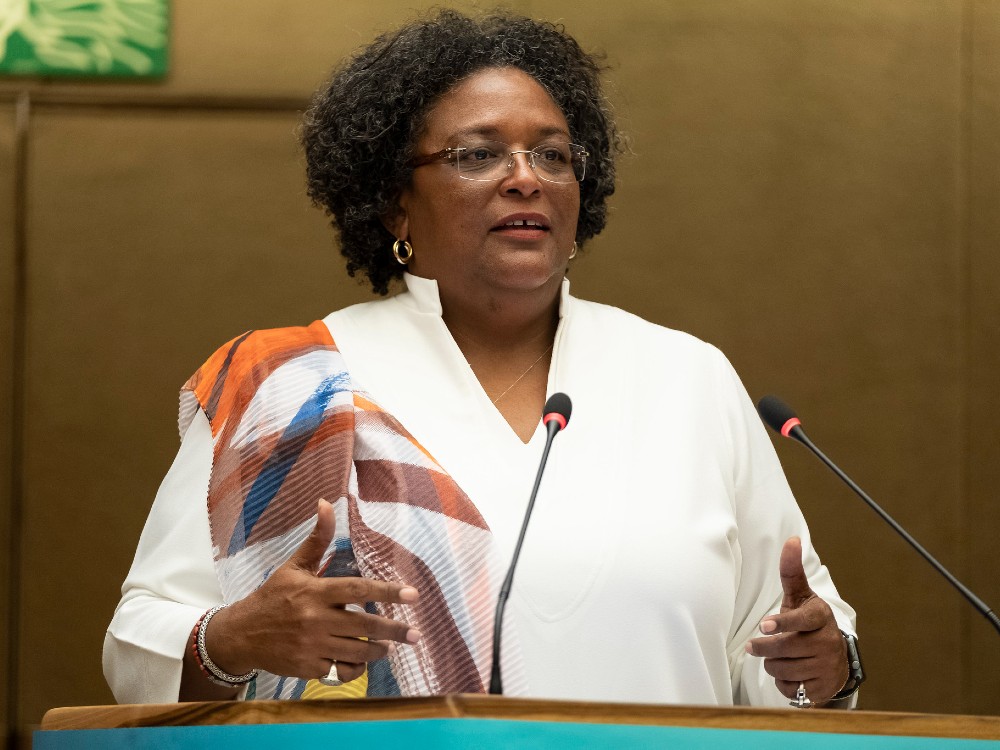

BRIDGETOWN, Barbados, Oct 6, CMC -Barbados Prime Minister Mia Mottley came to the official opening of the of the Caribbean Investment Forum (CIF2026) on Tuesday with her shopping list of what investments are needed in order to stimulate socio-economic growth in the region.
Moreover, her message to the estimated 500 delegates attending the three-day event, which the organisers said would focus on at least 30 bankable investment deals, is that “success is a habit”.
Mottley said that until the region develops the habit of success, “we are not likely to be able to meet the needs of the region because we become intimidated by the scale of the distance that we have to travel and that scale of distance, as with all due respect, cannot be 25 million dollars for a major regional investment forum.
“It has to be US$250 or US$2.5 billion, and how we get there must be the vision that we leave here with, but vision as we know it is not sufficient and what therefore is needed is the plotting of that journey.”
Outgoing chairperson of the Caribbean Export Development Agency (Caribbean Export), Dr Lynette Holder, highlighted the evolution of the forum since its inception in 2022, noting that the initiative has systematically shifted the regional narrative towards investment readiness and robust institutional governance.
Mottley said on too many occasions innovative ideas in the Caribbean did not lead to greater financial success because “the language of intellectual property was not understood by this region.
“In our case, too many of our people have innovative ideas, but they don’t have the capacity to do what? To scale,” she told the audience, citing her constant advice to her cabinet that “without scale, there is no transformation.
“Without scale, we have a pleasant discussion, a veranda conversation, an opportunity to fill five minutes on a stage and move to the next level. The Caribbean cannot move on this basis anymore.
“And I therefore welcome the fact that there are continued efforts by Caribbean Export to be able to create this opportunity to allow us to scale. But even as we are doing, if we are talking about green energy, and if we’re talking about digitalisation in the age of artificial intelligence (AI), then I regret to say that …US$20 million and US$$30 million will not cut it.”
She said the question therefore is “at what point do we seize this moment and seek to see how we can truly supercharge what is available for enterprise in this region?
“In my view, it is only going to be possible if we access the platforms that already exist,” she said, noting that it is necessary to bring all the other synergies within the industry together.
She said that this was determined by her government, which informed other stakeholders that “if you want to benefit from our support, the public dollar, the taxpayer’s dollar, then we need to start to see the synergies,” she said, noting that Barbados has a programme providing funding for hotels to stay afloat at a time when no tourists were coming, and hotels were closing down.
“…the only sure thing was that if you close a building for long enough, the tiles will blow and the pipes will stop working. The government insisted that was an unrealistic prospect in the same way that persons having to sever all of their employees was an unrealistic cost for the balance sheets of our tourism entities.
“We therefore set about to send a very clear message which remains as relevant today as it did when we set it out in the midst of COVID. That if you want to be able to have the benefit of our tax dollars, through incentives afforded to you, then you need to carry along other sectors in this economy that are equally dependent on the public purse, but for which the public purse does not have room to carry them at the same time that it is carrying you, the tourism sector.”
Mottley said she was saying so conscious that over BDS850 million (One BDS$=US$0.50 cents) dollars in tax incentives are awarded on an annual basis in Barbados, adding, “I could go to Jamaica, I could go to the Bahamas, I could go to other islands in the region and articulate the numbers; they are going to be more or less in the same ballpark.
“What matters, however, is how we leverage that further,” she said, noting that the area of training is one factor affecting investments across the region.
“We do not have sufficient training and ongoing training within almost every sector in our region and the truth is that it is going to be the quality of the output of our people that will always make the defining difference, not just in terms of our creativity which is natural and ebullient and pleasing, but also in terms of the internal discipline that we need to have to be able to master the different aspects of the ecosystem.”
She said that this ecosystem also involves participation in electronic single windows where such exists, noting that in the case of Barbados “we have at least reached a point where over 300 enterprises are now registered under the electronic single window, even as we perfect it by bringing in other services into the sphere of it.
“At the same time, we need to make sure that those persons there master the terms of our regional and international trade agreements, and very often the average business person in this region does not know what trade benefits are available to them, particularly in Caribbean Community ( CARICOM) agreements with the Dominican Republic, Costa Rica, Colombia, and I can go on”.
She said many businesses continue to relate to a North Atlantic framework because it’s comfortable, it’s readily available, and it does not require any effort to master a new market. “Those days can no longer sustain us. We need to recognise that in a world where regional trading blocks are rising more and more, we must master the understanding of what opportunities are available in Central America and in Latin America.”
She said, for example, in the area of food, “the logistics difficulties that we are facing globally and regionally, as well as the tariffs, as well as the determination to be able to put individual interests first, as we saw recently with our determination to ban the export of diesel from the United States of America,
“But it was no major shock because we have already been the victim of the banning of the export of natural gas after the last hurricane hit Puerto Rico, or the banning of ventilators from export restrictions that were placed on us in the COVID.
“We are accustomed in this new decade to the imposition of export restrictions by those countries who feel that they have a national vital interest to protect, and therefore to the extent that we have been dependent on one market and one market alone for supply, it exposes us in a very awful and difficult position.”
Mottley said that these things create opportunities, “and that is why I say that if we are going to be serious about expanding business and investment in this region, then it means us refocusing how we are going to get to scale, how we are going to accelerate, how are we going to leverage those larger industries”.
She said that the oil and gas sector in Guyana and Trinidad and Tobago and soon Suriname, the output there of those sectors alone create a platform base from which other money and other businesses can be sustained.
“I therefore ask us to look at the Caribbean as a joined-up equation. We talk about it, and even when we talk about it, those institutions that most reflect it are those that are most beleaguered at the moment.”
Mottley said she was also calling on the Caribbean to equally recognise that technology presents opportunities “to us that were not available to our fathers and grandfathers 30 and 60 years ago.
“And to that extent, therefore, how do we use that technology in the case of goods to appropriately market and tell the story, and in the case of services, to deliver the services more efficiently to the customer who may be global and who can truly benefit from it?
“From legal services, we have the whole market of the Commonwealth of those countries that are based on the common law, but we seem to believe that we only have a small market locally.”
Mottley said that small market locally is then held on zealously “such that things that ought to be the subject of modern reform are ignored,” making particular reference to the reform of land transactions, which continues to be a major economic drag in this region with respect to the timelines and the capacity “to be able to prove what we need to prove for efficiency to attach itself and confidence to attach itself to those transactions”.
Mottley said in a very real sense, “part and parcel of what we have been seeing in this region and globally in a post-COVID environment is a determination to recover losses in the shortest possible time without understanding that excessive, egregious behaviour has also the capacity to recreate the bubble that we saw 100 years ago when it led to the stock market crashes”.
She warned that if the Caribbean continues along that path, they would find the system broken “and then you can get it all for nothing, largely because too far east is always west again and if we seek to be able to extract that which cannot be sustained, then the only inevitable outcome is likely to be failure”.
CMC/pr/ir/2026