



By Peter Richards
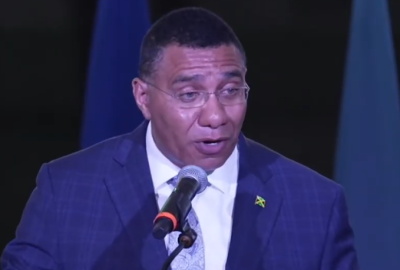
BASSETERRE, St. Kitts, Feb 24, CMC – Jamaica Prime Minister Andrew Holness has underscored that, despite being part of the 15-member regional integration grouping, CARICOM, it “is not and has never claimed to be a political union”.
Holness, speaking at the ceremonial opening of the 50th ordinary meeting of the Caribbean Community, said that the CARICOM treaty does not mandate a singular foreign policy or a supranational authority.
“We meet at a time when the speed of global change is outpacing the speed of regional coordination. Climate shocks arrive faster than our financing mechanisms, and criminal networks adapt faster than our institutions. Technological disruption is reshaping economies faster than our regulatory and skills frameworks can adapt.
“These challenges do not wait for us to be comfortable to align policy resources and action. The question before us, therefore, is not whether CARICOM can endure, for we have and we will, but whether it can deliver for our people with urgency and relevance in a rapidly changing world for decades. An idealised narrative around the Caribbean integration, while well intentioned, has framed perhaps unrealistic expectations within our respective populations.”
He said that it has also, perhaps unintentionally, diminished the genuine strengths of the existing arrangement, “an association of independent states, bound not by uniformity, but by shared purpose, mutual regard and a deep history of collaboration”.
Holness said that because the members are sovereign states, “each accountable to our own electorates, we will, at times, assess risks differently, sequence priorities differently, or interpret geopolitical opportunities differently.
“That is not evidence of the weakness of our association. This is the natural expression of sovereign democracies navigating an increasingly turbulent global environment. “
He said that too often, differences in national perspectives are portrayed as fractures threatening the regional project, adding, “I submit that they are nothing of the sort.
“… while there are undoubtedly circumstances where one voice has and will work for us to great effect globally, variations in national perspectives is not a liability to be feared. It is a resource to be harnessed.”
He said that the measure of the Caribbean integration should therefore “not be uniformity of position, but effectiveness of cooperation, indeed, political traditions, development strategies and governance approaches are one of CARICOM’s most under-appreciated strengths”.
Holness said that each member state functions as its own laboratory of democracy, able to test policy innovations that others can study, refine, and adapt. This is that divergence.
“It is distributed, regional problem solving. I offer Jamaica’s approach to security as the first example. For decades, we have confronted levels of violence more severe and more persistent than elsewhere in the region.
“It has forced us to develop responses, legislative, operational, community-based and technological that may now offer lessons for sister states encountering emerging criminal threats. Our region’s variability, therefore, is not an obstacle to integration. It is integration, practical, organic, and rooted in shared learning, rather than a forced concept of uniformity.”
But he noted that even as sovereign states with sometimes differing priorities, there are core challenges, such as regional security, that bind the countries together and demand deeper cooperation.
Organised criminal networks are increasingly sophisticated, technologically enabled, better armed, and not constrained by national boundaries. This week’s events in Mexico exemplify that, left unchecked, such networks can grow powerful and brazen enough to challenge the state itself. The Montego Bay Declaration on transnational organised crime and gangs, adopted during Jamaica’s chairmanship, marked an important step in establishing a unified regional stance. “
Holnes said that this work must continue through intelligence, sharing, joint operations, interoperable border management systems, and stronger alignment with regional and international partners.
He said that there is also the closely related matter of territorial integrity, as small states with vast maritime spaces and strategically important geographies, “we each face pressures, external claims, illicit incursions and evolving geopolitical interests that can challenge the sanctity of our borders, while our approaches may differ, our commitment to the principle is shared.
“Every member of CARICOM has the right to decide to defend its territory and maritime domain, and it is reasonable for them to expect the solidarity of every member state to that end.”
He told the regional leaders, regional and international diplomats, as well as guests from Saudi Arabia, the United Arab Emirates, and the Commonwealth Secretariat, that during Jamaica’s tenure as CARICOM chair, it placed significant emphasis on regional security, strengthening collaboration with CARICOM impacts, deepening engagement with Interpol, and advanced coordinated efforts on border management and intelligence sharing on Haiti.
“We reaffirmed that CARICOM has a critical role in supporting the political, humanitarian and security pillars of the recovery, Jamaica remains fully committed to the work of the United Nations Security Council endorsed gang suppression force, the standing group of partners, the Eminent Persons group and the Organization of American States (OAS) in supporting a coherent and sequenced pathway towards stability in Haiti, adding aso “we must address the situation in Cuba with clarity and courage.
“Cuba is our Caribbean neighbour. Its doctors and teachers have served across our region. Its people are part of our shared history, but today, the Cuban people face severe economic hardship, energy shortages, and growing humanitarian strain. Jamaica is sensitive to the struggles of the Cuban people.
“Humanitarian suffering serves no one apart from our fraternal care and solidarity with the Cuban people. It must be clear that a prolonged crisis in Cuba will not remain confined to Cuba. It will affect migration, security, and economic stability across the Caribbean Basin.
“It is therefore important that we carefully consider this matter and take collective action. Let there be no doubt, Jamaica stands firmly for democracy, human rights, political accountability, and open market-based economies. We do not believe that long-term stability can exist where economic freedom is constrained, and political participation is limited,” Holness said.
He said that sustainable prosperity requires openness to ideas, to enterprise, to investment, and to the will of the people.
“This moment therefore calls not for rhetoric, but for responsible statecraft, even as we encourage support for humanitarian relief, Jamaica supports constructive dialogue between Cuba and the United States aimed at de-escalation, reform and stability, we believe there is space, perhaps more space now than in years past, for pragmatic engagement that protects the Cuban people from any further deterioration in their circumstances, and instead promotes national and regional prosperity”.
Holness, in his address,s said that the geopolitical environment is shifting and that “this may well be a moment of opportunity, a moment for transition, for recalibration, for a new chapter. “CARICOM can play a constructive role, not as an ideological block, but as a community of democratic states offering cooperation, economic reform and social development,” Holness said, adding, “This is not a moment for division in our community.
“It is a moment for maturity, for principled realism, and if we act wisely, for positive change in our hemisphere. This brings me to the second shared challenge, navigating the transformation of the global system itself.”
He said that the new geopolitical and economic environment is being shaped by strategic rivalry, supply chain realignment, a new era of trade protectionism, and rapid technological disruptions.
He said powered by artificial intelligence control over information platforms, standards, algorithms and networks now influence economic power, national security and policy autonomy as profoundly as control over physical resources once did for small states, the risk of marginalisation in this environment are real, but so too are the opportunities for leapfrogging “if we act deliberately, digital capability is now a component of sovereignty.
“States that do not shape our technologies deployed will increasingly find their policy space shaped by others. Small states cannot afford to be passive observers of these shifts. Yet here again, CARICOM’s diversity is an asset, because we are not bound to a single foreign policy.”
He said different member states can cultivate different diplomatic, commercial, and strategic relationships.
“Rather than viewing this as fragmentation, we should recognise it as an opportunity, multiple points of engagement in a complex global system that can collectively enhance the region’s resilience, influence, and optionality.
“No single Caribbean state can build scale across these domains alone, but together, we can pull talent, align standards, and develop digital public infrastructure to enhance productivity, inclusion, and resilience.
“Success will, however, require deep engagement, information sharing, and collaboration with each other. It will require true, enhanced cooperation. For our part, Jamaica remains committed to a transparent, fair, and rules-based multilateral trading system that is responsive to the vulnerabilities of small island developing states, while enabling us to compete and thrive in a tech-driven global economy.”
Prime Minister Holness said that the Caribbean single market and economy (CSME), which allows for the free movement of goods, services, skills, and labour, “remains one of our most important instruments of translating regional cooperation into real economic opportunity.
“It is a practical framework that allows member states to pool advantages, reduce barriers and create a larger economic space in which our firms, workers and innovators can compete.
“The strength of the CSME lies in its flexibility. It allows integration where our interests converge, while giving each country the room to sequence reforms at its own pace. Our task is to make the single market work better by improving connectivity, aligning standards where it matters, easing the movement of skills, and building compatible digital and logistics infrastructure so that scale is possible even for the smallest among us”.
Holness said that the CSME is essential to building resilience, raising productivity, and ensuring that Caribbean enterprises can thrive in an increasingly competitive global economy.
CMC/pr/ir/2026