



By Staff Writer
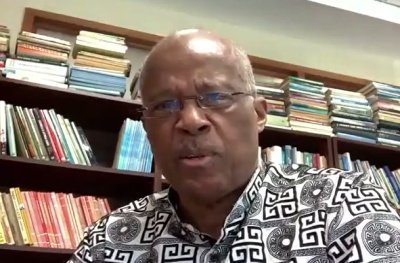
BRIDGETOWN, Barbados, Apr 7, CMC – The chairman of the Caribbean Community (CARICOM) Reparations Commission (CRC), Professor Sir Hilary Beckles, has criticised the decision of the United Kingdom to abstain from voting on a United Nations resolution which recognised the transatlantic slave trade as the “gravest crime against humanity”.
While the resolution filed by Ghana was supported by 123 countries, the UK joined 52 other countries in abstaining, citing concerns over creating a “hierarchy of historical atrocities”.
But speaking at a news conference, Sir Hilary, who is also the Vice Chancellor of the University of the West Indies (UWI), said the legacy of the slave trade is still hampering development and all of the things that humans are expecting from their realities.
“We have had some pushback in this regard, because those slave-owning nations that created this scenario, that built this global chattel slavery around the African people, and have benefited enormously from that.
“When we consider that Britain, for example, had 200 years of free labour, 200 years of free labour from 10 million African people, yet these nations abstained from agreeing to this resolution.
“And we know why they have done so. The arguments they have used are really not acceptable to meaningful historical or political analysis,” said Sir Hilary, a renowned historian.
He said the notion that chattel slavery and the creation of property rights and human beings, which was legal because they made it so, indeed adds to the criminality of the situation and the gravity of it.
“Because what these apologists are suggesting is that, yes, we made it legal and therefore it was. And those people who were the victims of it, who had their humanity denied, the humanhood denied in the process of this horrendous crime, had no say in the conversation. “But the history shows very clearly that there were always people in Britain, there were always people in Europe who were saying from the very beginning that this is wrong. This is a crime. This is not only a religious sin, but it’s an abomination, and it has to stop.”
But Sir Hilary told reporters that the governments who framed and created this system and who enabled their private sector to accumulate wealth using this system, “those institutions, the civil society who benefited financially from this system, all of those persons were in harmony with their governments because their governments took the decision that the chattel enslavement of African people was in their national interest”.
He said when the government declares and legislates that a system is in the national interest, then the state has to be held accountable because the state knew that what they were doing was “criminal, unprecedented in human history.
“And so we are calling for the dialogue to continue. We are calling for the best possible minds to be gathered to discuss the way forward. There has to be reparatory justice. There can no longer be a denial of reparatory justice.”
Sir Hilary, who had earlier described the adoption of the UN resolution as a “historic, landmark decision”, said that a few days ago, he heard a leading British political leader making the statement that all of this was a long time ago.
“It was not a long time ago. It’s very much in the presence of us all. There are still many people in the Caribbean world, …who know their great-grandparents, their great-grandparents, their great-great-grandparents who were enslaved. And we (6:10) have memory of them.
“This is a living reality within Caribbean families. It is not something that happened during the Roman Empire. This is within our own lifetime, our own experiences. So what we are calling for is a dialogue of decency.
“We’re calling for a dialogue of decency that is part of the discourse of development. Those who have benefited from the criminality of this system ought to be in a position to rise up and engage the victims, those who are still suffering the consequences of this crime, to have that dialogue, to have that dialogue of decency, to talk about how best to repair and to move on.”
He said in other words, in the CARICOM Reparations Commission, “we are of the view that reparatory justice is part of our development conversation.
“We wish to have our economies modernised. We’ve inherited the colonial mess. We have been cleaning up this colonial mess left behind by slavery and colonisation, three to four hundred years of that.
“And those who benefited from it walked away, leaving a mess behind that the victims of that same slavery and colonisation now have to repair. We have issues with economic development.
“We have issues with healthcare. We have education issues. The infrastructure of nation-building was less severely impaired by the European colonisers. So the conversation is about development.”
Sir Hilary said the conversation is about repairing the economic, social, and cultural resources that are necessary for human development.
“And therefore we say that reparatory justice is about enlightenment. It’s the enlightenment of the 21st century. It’s humanity seeking to reset itself. It is about a new renaissance in the modern world.
“And as we can see what is taking place all around us, humanity is indeed in need of a reset. And we believe that the reparatory justice movement will indeed be the foundation and the basis for a new 21st-century vision about human development. From that perspective, then, we are absolutely convinced that this is the moral thing to do.”
The CRC chairman said that it is the legal and ethical thing to do.
“And so we remain steadfast. What is required now is a dialogue. CARICOM has been calling for a summit where governments can sit, where governments can sit and discuss and debate this.
“As I have said in the spirit of decency, this is what we are hoping for. And probably I do believe that the resolution at the United Nations has laid the foundation for this dialogue of human decency,” Sir Hilary added.
CMC/gh/ir/2026