



By Staff Writer
PORT OF SPAIN, Trinidad, Jan 28, CMC – Government and opposition leaders provided contrasting views on the failure of the Zones of Special Operations Bill (ZOSO) in the Senate on Tuesday night, three days before a state of emergency (SoE) that has been in place since last year comes to an end.
The Kamla Persad-Bissessar administration had needed at least four independent legislators to support the legislation that had been modeled on the Jamaica ZOSO bill, but when the matter was put to a vote after several days of debate in the Senate, eight of the nine independent legislators voted against, with the other abstaining.
The six opposition People’s National Movement (PNM) legislators had voted against the measure, while the government’s 15 members voted in favour.
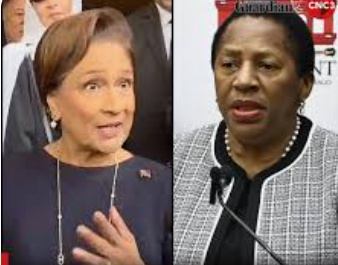
Opposition Leader Penelope Beckles, in a post on Facebook, praised the legislators “who stood up for the people”, adding that the “collapse of the Zones of Special Operations Bill in the Senate… proves that democracy is alive and well in Trinidad and Tobago”.
She said the defeat on Tuesday night had been “a good night, Trinidad and Tobago. No to ZOSO. No to this wicked Government”.
But Prime Minister Persad-Bissessar, who prior to the debate in the Senate had launched a scathing attack on the independent legislators appointed by President Christine Kangaloo, said she was not surprised at their vote.
“Why would I be disappointed?” she said, adding, “They have shown the entire country that I was right about them. I am quite satisfied that they have proven me right.
“The people that are happy are the local drug mafia and gang members who stand to benefit from the votes of the nine bootlickers,” she said, adding that independent senators have done “irreparable damage” to their bench.
“They have not an iota of credibility now in the eyes of the population,” she said.
The ZOSO legislation was passed in the House of Assembly nearly two weeks ago, and unlike the Lower House, where the government enjoys the necessary two-thirds majority to ensure its passage, the government needed support at least from four independent legislators for the measure to become law.
Prime Minister Persad-Bissessar had caused a major national outcry before the bill had been debated in the Senate when she had been critical of the independent legislators, referring to them as “‘bootlickers and brown-nosers.’
“These shameless President’s senators had no courage to contest any election to sit in that Parliament, they are not there because of the will of the people. The entire country knows that these people were appointed because they are bootlickers and brown-nosers,” she told the Trinidad Express newspaper, when asked if she regretted her earlier comments on the nine legislators appointed by President Kangaloo, who she described as a “low-level PNM functionary.
“It is obscene that these nine people, whose only special ability is bootlicking and self-promotion on the local cocktail and conference circuit, and who no one voted for, can decide on legislation brought to Parliament by a Government who was voted for by the electorate.
“And the most egregious ones have absolutely no shame standing in front of Parliament to defend their eating ah food. Yet they won’t stand in front of the electorate and ask for a vote to be in Parliament,” Persad-Bissessar told the newspaper.
Persad-Bissessar said her Government has comprehensive plans to address crime should the ZOSO bill fail to secure the required three-fifths majority for passage in the Senate.
During the debate on Tuesday, Attorney General John Jeremie said that the ZOSO legislation was necessary for the gains obtained during the SoE not to be diminished.
Jeremie said the government would not be making any amendments to the 28 clauses in the bill, and during the Committee Stage of the bill, where amendments are usually considered, he said there was no time to fully ventilate the almost 50 amendments proposed by both independent and opposition benches.
“We are maybe 72 hours away from the end of the state of emergency, and we wish to have something in place by then,” Jeremie said, even as Independent Senator, Anthony Vieira expressed disappointment with the government’s position.
“When I listened to you and Minister (Wayne) Sturge initially, I was under the impression that government might have been open to taking amendments,” Vieira said.
But Jeremie insisted that the amendments proposed by the independent legislators were “substantial” and should not be dismissed quickly.
“We will not be close to that before the 31st, and something will have to be put in place on the 31st. That is what our intelligence agencies tell us. I apologise for that, because that is not the way we normally do business. But then this debate has gone on for a considerable period of time,” Jeremie added.
One of the major amendments proposed was to insert a “sunset clause” into the bill, which is essentially an expiration date. Independent Senators argued that it would allow the government and parliament the opportunity to review the law and its effectiveness.
However, Jeremie again rejected that suggestion.
“Why no sunset clause? We say the bill does not require a sunset clause because clause 28 already provides for a review by way of a parliamentary committee. Further, the bill is not a short-term measure to address criminality and escalating levels of violence in a society.
“There’s another reason why there’s no sunset clause on it, and this has to do with the soft part of the legislation, the Social Transformation Committee. Once that starts, I’m told by my colleagues in Jamaica that that is actually a very powerful tool in terms of getting the communities to buy into the fact that life can be better without the gangs. They can access services, they can come out of their houses, they can do things that they would not normally do.”
The ZOSO bill would have given the Prime Minister, in consultation with the Police Commissioner and Chief of Defence Staff, the authority to designate specific high-crime areas as “Zones of Special Operations” (ZOSOs) where criminal activity is deemed serious and escalating.
Once a zone is declared, the legislation would grant expanded powers to a joint police and military command. These included the ability to deploy combined security forces into the area, establish security cordons for up to 24 hours, impose curfews lasting as long as 72 hours, and conduct searches without a warrant under certain conditions. Officers could also detain individuals suspected of involvement in criminal activity, subject to limited court oversight.
A ZOSO could have remained in effect for up to 180 days.
The Law Association of Trinidad and Tobago had also raised concerns about the legislation.
In a statement, the LATT said its views were not sought before the ZOSO legislation, raising concerns about provisions in the Bill that allow body worn cameras to be used “as far as is possible having regard to available resources”.
The law association said the wording weakens accountability, adding “the experience of our members has been that this has been used as a ready excuse not to use cameras.
“Given that the creation of Zones results in the suspension of some constitutional rights, we recommend that it be made compulsory that body cameras be used or some other recording device.”
The LATT is also recommending that police officers identify themselves or provide their regimental numbers when confronting people suspected of criminal activity.
It has also sought further sought clarification on detention provisions under Section 18(3) of the Bill, which allows a magistrate to order a detainee to appear before the High Court.
The LATT questioned how long a suspect could remain in custody after being brought before the court, how long a person could be detained without charges being laid, and whether a suspect should be released if there are delays in laying charges.
CMC/ah/ir/2026