

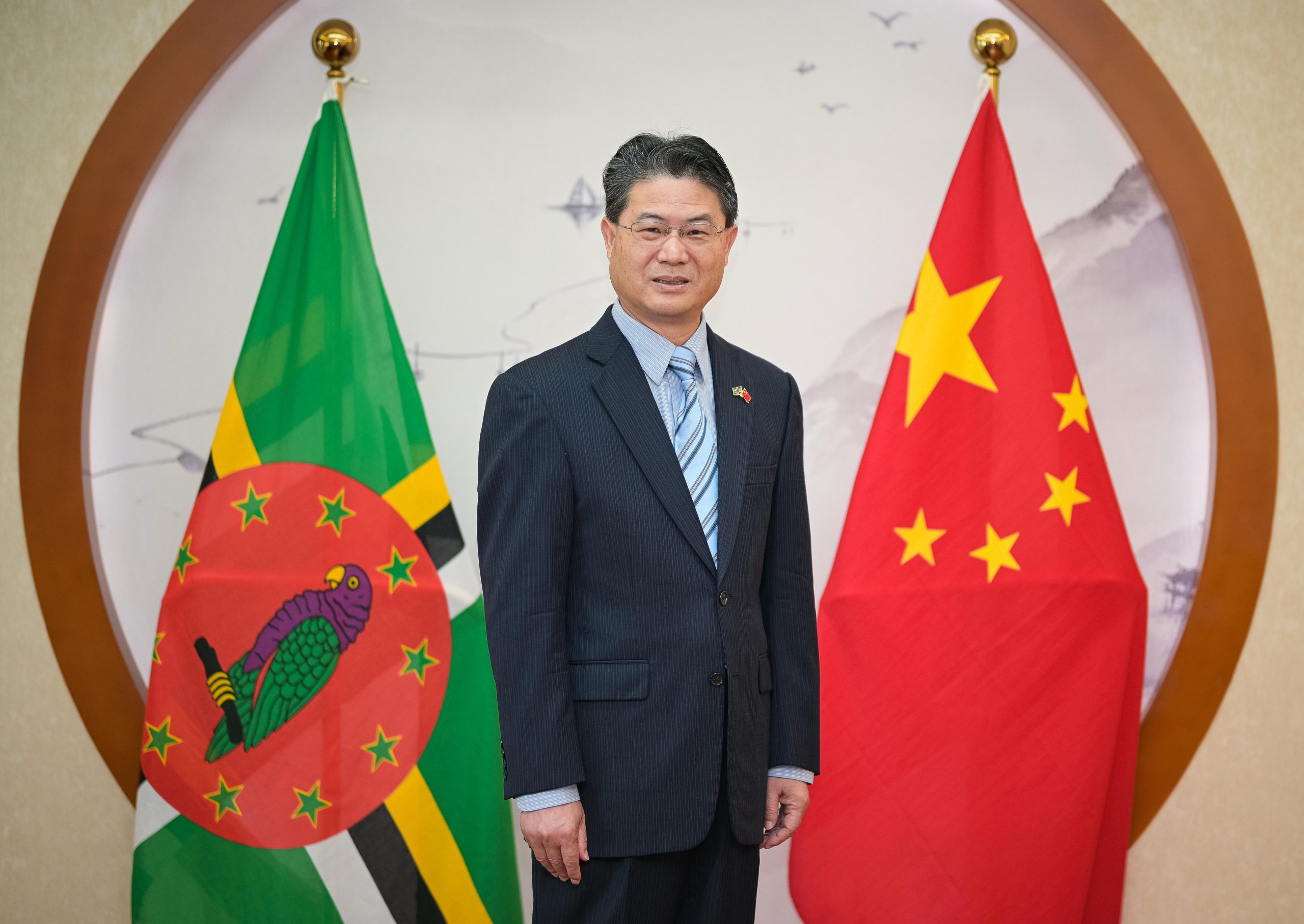


Chinese Ambassador to Dominica H.E. Ambassador Chu Maoming held a press briefing earlier this month.
We now produce the entire speech
Dear Friends from the Media,
Good morning! Thank you for taking the time to attend this press briefing. It is a great pleasure to meet you all again at the Embassy. Last week, the 2026 Two Sessions of China, namely the Fourth Session of the 14th National People’s Congress (NPC) and the Fourth Session of the 14th National Committee of the Chinese People’s Political Consultative Conference (CPPCC), successfully concluded in Beijing. The Two Sessions are not only a major event in China’s annual political life, but also an important window for the world to observe China. Today, I will brief you on the important outcomes of this year’s Two Sessions and interpret the direction of China’s development in the years ahead.
I. China’s Development Achievements in 2025
The Report on the Work of the Government adopted by the NPC points out that the year 2025 stood out as truly remarkable. Amidst profound and complex developments both at home and abroad, we steadfastly applied the new development philosophy and pursued high-quality development, kept in mind both domestic and international imperatives, successfully accomplished the main objectives and tasks for economic and social development for the whole year, brought the 14th Five-Year Plan to a successful conclusion, and made solid new strides in advancing Chinese modernization.
In the economic sphere, China’s economy remained generally stable and registered steady growth, with its gross domestic product (GDP) growing by 5 percent and reaching 140.19 trillion yuan (19.63 trillion USD). Foreign trade registered rapid growth, significant advances were made in export diversification, and a basic equilibrium was maintained in the balance of payments, demonstrating remarkably strong resilience.
In terms of development, new, quality productive forces grew steadily, and numerous new advances were made in science and technology. China led the way in the research, development, and application of artificial intelligence, biomedicine, robotics, and quantum technology. Breakthroughs were made in the independent research and development of chips, the large-scale application of the BeiDou Navigation Satellite System was extended across various sectors, Fujian, China’s first domestically built aircraft carrier equipped with an electromagnetic catapult system, was officially commissioned, and the output of new-energy vehicles exceeded 16 million units.
In opening up, China took the initiative to open wider and advanced unilateral opening up in a well-ordered way, steadily expanding both unilateral visa-free entry policies and comprehensive mutual visa exemptions. Imports and exports maintained stable volume and higher quality, with exports growing by 6.1 percent. The number of newly-established foreign-funded enterprises increased by 19.1 percent. Island-wide special customs operations were launched in the Hainan Free Trade Port. We took solid steps to advance high-quality Belt and Road cooperation, further boosting practical cooperation in various fields.
In green development, China vigorously promoted pollution prevention and control, and the overall quality and stability of the ecosystem were further enhanced. We accelerated the green and low-carbon transition of key industries; the installed capacity of new-type energy storage exceeded 130 gigawatts, and the share of non-fossil energy in total energy consumption reached 21.7 percent. China announced its 2035 Nationally Determined Contributions to respond to climate change, fully demonstrating our commitment as a responsible major country.
In diplomacy, my President H.E. Xi Jinping attended a series of major multilateral and bilateral events. China successfully hosted major diplomatic events such as the Commemoration of the 80th Anniversary of the Victory of the Chinese People’s War of Resistance against Japanese Aggression and the World Anti-Fascist War, the Shanghai Cooperation Organization Tianjin Summit, the Global Leaders’ Meeting on Women, and the Fourth Ministerial Meeting of the China-CELAC Forum. We proposed the Global Governance Initiative, continued to promote the building of a community with a shared future for humanity, and played a positive and constructive role in addressing global challenges and resolving regional and international hotspot issues.
In addition, 2025 marked the conclusion of the 14th Five-Year Plan. Looking back over the past five years, China has made remarkable achievements that have attracted worldwide attention. The economic aggregate reached new heights, with GDP successively crossing the thresholds of 110 trillion yuan (15.40 trillion USD), 120 trillion yuan (16.80 trillion USD), 130 trillion yuan (18.20 trillion USD), and 140 trillion yuan (19.60 trillion USD), registering an average annual growth rate of 5.4 percent, well above the global average. New breakthroughs were achieved in technological and industrial innovation, with a number of major core technologies in key fields conquered; the value-added of the manufacturing sector has ranked first in the world for 16 consecutive years. High-standard opening-up continued to expand, China’s status as the world’s largest trader of goods was further consolidated, and deeper and more substantive progress was made in high-quality Belt and Road cooperation. Fresh progress was achieved in ecological conservation: China has become the country with the fastest and largest increase in forest resources in the world, and has built the world’s largest and fastest-growing renewable energy system.
II. China’s Development Goals for 2026
You may recall that last November, I briefed you at the Embassy on the relevant information of the Fourth Plenary Session of the 20th Central Committee of the Communist Party of China (CPC) and gave a preliminary introduction to the 15th Five-Year Plan. At this annual session of the NPC, the Outline of the 15th Five-Year Plan for National Economic and Social Development of the People’s Republic of China (2026–2030) was formally adopted, translating the strategic plans of the Party Central Committee into the government’s action blueprint and policy arrangements for China’s economic and social development in the next five years.
Specifically, the Outline has specified 20 main indicators covering five areas for China’s economic and social development during the 15th Five-Year Plan period. Among them, in the area of economic development, it is proposed that GDP should keep growing within an appropriate range, with annual growth rates to be determined in light of actual conditions, laying a solid foundation for achieving the goal of doubling China’s 2020 per capita GDP by 2035 to reach the level of a moderately developed country. In the area of innovation-driven development, it projects an annual average increase of at least 7 percent in nationwide R&D spending. In the area of public well-being, seven targeted indicators are set covering employment, income, education, medical care, health, elderly care, and childcare. In the area of green and low-carbon development, it envisages a total reduction of 17 percent in carbon dioxide emissions per unit of GDP, and continues to promote the green and low-carbon transition across key sectors. In the area of security safeguards, two indicators related to food and energy production capacity are proposed.
2026 is the first year of implementing the 15th Five-Year Plan. China will focus on the goals and tasks set out in the Plan, work solidly to ensure the implementation and effectiveness of various policies and measures, and strive to get off to a good start in the 15th Five-Year Plan period. The main projected development targets for this year are as follows: GDP growth of 4.5–5 percent, while striving for better results in practice; surveyed urban unemployment rate of around 5.5 percent, with over 12 million new urban jobs; CPI increase of around 2 percent; personal incomes rising in step with economic growth; a basic equilibrium in the balance of payments; grain output of around 700 million metric tons; and a reduction of around 3.8 percent in carbon dioxide emissions per unit of GDP.
III. How China’s 2026 Policies Will Benefit Dominica
This year, the Chinese government will focus on solid work in the following areas: building a robust domestic market, fostering and strengthening new growth drivers at a faster pace, moving faster to achieve greater self-reliance and strength in high-level science and technology, continuing to deepen reform in key areas, further expanding high-standard opening-up, advancing all-around rural revitalization, promoting new urbanization and coordinated regional development, taking stronger measures to ensure and improve the people’s wellbeing, accelerating the green transition across the board, and strengthening risk prevention and mitigation and security capacity building in key areas. Many of these policies also bring new opportunities for Dominica.
China will further expand high-standard opening-up. We will adhere to win-win cooperation, steadily expand opening up at the institutional level, and promote broader international economic flows, so as to advance reform and development through opening up. We will promote the negotiation and signing of more regional and bilateral trade and investment agreements, and safeguard and develop an open world economy. We will actively expand imports and promote balanced development of trade, and improve the level of cross-border trade facilitation. We will pursue high-quality Belt and Road cooperation, strengthen strategic alignment with participating countries, and take solid, well-measured steps to promote stronger infrastructure connectivity, greater connectivity on rules and standards, and closer bonds with the people in these countries. We will coordinate the development of major signature projects and “small and beautiful” public well-being projects, expand practical cooperation in emerging fields, so that the fruits of cooperation will benefit the people of all countries more.
“To prosper oneself is to prosper all under heaven” is an ancient maxim passed down by our ancestors thousands of years ago, and it is also the global vision that China has always upheld. The Chinese people not only aspire to a better life for themselves, but also wish for the people of all countries to live well. Faced with the rampant spread of unilateralism, protectionism, and power politics, China has always demonstrated its sense of responsibility, practiced true multilateralism, advanced inclusive economic globalization, and promoted the common development and prosperity of the world.
On the one hand, China is the second largest trading partner of Latin America and the Caribbean, and China’s super-large market offers broad prospects for economic and trade cooperation with regional countries, including Dominica. Dominica boasts many unique agricultural products and high-value-added goods, such as coconut products, rum, and traditional handicrafts. We encourage the Dominican side to actively participate in exhibitions and fairs in China, including the China International Import Expo, the Canton Fair, and the China International Consumer Products Expo, to introduce these competitive products to Chinese consumers.
On the other hand, under the framework of the Belt and Road cooperation, practical cooperation between China and Dominica in various fields has been continuously expanded and deepened. In infrastructure development, key projects such as the International Airport constructed by CR5 and the 6 reconstructed schools aided by China are being advanced with high quality and efficiency. The smooth completion and handover of these projects and their early benefit to the people are the common aspirations of both China and Dominica. “Small and beautiful” projects, such as the construction of riverbank protection walls, house renovations, and playgrounds in communities, have effectively improved people’s lives. In agricultural cooperation, the Chinese agricultural technical cooperation team has been rooted in Dominica for more than 20 years. With rich experience, advanced technology, and hard work, the team has transformed Dominica’s superior agricultural resources, such as abundant sunlight, fresh water, and fertile land, into high-quality, high-value-added specialty agricultural products, helping Dominica strengthen food security and advance agricultural modernization. In medical cooperation, the Chinese medical team has provided high-quality diagnosis and treatment to the local people year after year, cured countless complicated cases, and trained several clinical reserve talents for the local area. Next week, a new batch of medical team members will arrive in Dominica for handover. I wish them every success in their work here.
China will accelerate the green transition across the board. We will take carbon peaking and carbon neutrality as the guide, make coordinated efforts to cut carbon emissions, reduce pollution, pursue green development, boost economic growth, and vigorously develop a green and low-carbon economy. We will improve the policies for promoting green and low-carbon development, foster new growth drivers such as hydrogen power and green fuels, exercise tight and effective regulation over energy-intensive and high-emission projects, and accelerate efforts to phase out outdated production capacity. We will actively yet prudently work toward peaking carbon emissions and achieving carbon neutrality, implement the system of controlling both the total amount and intensity of carbon emissions, improve the systems for carbon emissions statistics and accounting as well as carbon footprint management, and further expand the coverage of the carbon emission trading market. We will strive to build a new electric power system, accelerate the construction of smart grids, develop new types of energy storage, and promote more extensive use of green electricity.
Green development has always been an important issue of common concern to both China and Dominica. Faced with the global challenge of climate change, President Xi once pointed out, “Confronted with unprecedented difficulties in global environmental governance, the international community must act with unprecedented ambition and action, shoulder its responsibilities bravely, work in concert, and jointly build a community of life between man and nature.” At present, China has established the world’s most systematic and comprehensive policy system for carbon emission reduction and has become one of the countries with the fastest decline in energy intensity in the world. Meanwhile, we have provided 70 percent of the world’s wind power equipment and 80 percent of photovoltaic module equipment, driving a significant drop in the cost of global wind and photovoltaic power generation and helping developing countries reduce carbon emissions. Recently, I have noted that the local geothermal power stations have been gradually put into operation, marking another step forward for Dominica in developing green energy and achieving its goal of becoming the first climate-resilient country. Going forward, China and Dominica can further strengthen cooperation in the field of green energy development, turning natural endowments such as solar and geothermal energy into environmental and economic benefits.
Cooperation on disaster prevention and mitigation is also a topic we often discuss. Environmental protection, climate change, and disaster reduction cooperation are all listed as important components in the outcome documents of the Fourth Ministerial Meeting of the China-CELAC Forum held last year and the newly released China’s Policy Paper on Latin America and the Caribbean. The 15th Five-Year Plan clearly states that we will enhance our capacity to address climate change, especially extreme weather events, and deepen South-South cooperation on climate change. In the future, China and Dominica can leverage the framework of the China-CELAC Comprehensive Disaster Risk Management Cooperation Mechanism and channels such as the Climate Adaptation and Comprehensive Natural Disaster Response Fund under the CELAC framework to strengthen cooperation in disaster prevention and mitigation, disaster monitoring and early warning, risk assessment, emergency preparedness, rescue capacity building, and post-disaster reconstruction.
China will continue to safeguard international fairness and justice. At present, the world is undergoing profound changes and turbulence, with frequent geopolitical conflicts, a growing deficit in global governance, and prominent security issues; unilateralism and protectionism are on the rise, threats from hegemonism and power politics are mounting, the international economic and trade order is facing severe challenges, and the world economic growth momentum is insufficient with accumulating risks; major-country competition has become more complex and intense, and uncertainties and instabilities have increased markedly.
In this regard, China stands ready to work with the international community including Dominica to advocate an equal and orderly multipolar world and universally beneficial and inclusive economic globalization, promote the implementation of the Global Development Initiative, the Global Security Initiative, the Global Civilization Initiative and the Global Governance Initiative, actively participate in the reform and development of the global governance system, and make the international order more just and equitable. We will join hands to build a community with a shared future for humanity and create a bright future of peace and development for our world.
Dominica is an important country in the Eastern Caribbean region and a trusted friend and partner of China in this region. As fellow members of the Global South, China and Dominica should join hands to safeguard the international system with the United Nations at its core and the international order based on international law, and strengthen coordination and cooperation in the United Nations and other international organizations. China is fully aware that, as a small island developing state, Dominica faces special challenges in climate change, ocean governance, economic resilience building, and other fields. China will, as always, support Dominica’s reasonable concerns and legitimate demands on these key issues and work together to safeguard the common interests of the vast number of developing countries.
That concludes my briefing. I am now ready to take your questions.