
By Staff Writer
UNITED NATIONS, Sept 2026, CMC – Dominica on Tuesday called for new financing mechanisms that allow countries like Dominica to move faster, as well as developing partnerships that make the energy transition an engine of economic development and growth.
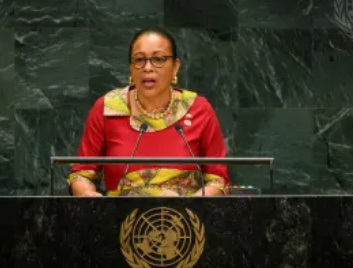
Addressing the 81st session of the United Nations General Assembly (UNGA), President Sylvanie Burton said Dominica’s ambition is not merely to generate clean electricity, but to use clean energy to transform its economy, adding that the international community has become very good at recognising vulnerability.
“We have become less successful at financing the transformation that vulnerability requires. Too often, the cycle is predictable. A disaster occurs, infrastructure is destroyed, and economic activity collapses.
“We then mobilise resources to rebuild what was lost, often through borrowing that substantially increases debt to rebuild what we could have made more resilient from the outset.”
Burton said that this is not an efficient financial model, insisting that the best time to build resilience is before disaster.
“The best time to finance transformation is before crisis, and the value of resilience should be measured not only by what we build, but by what we prevent from being destroyed,” Burton said, telling the UNGA that Dominica does not come to the United Nations asking to be treated as a victim of vulnerability.
“We come asking to be recognised as a partner in transformation. We must finance potential, not merely manage vulnerability. And this is not only about Dominica. It is about whether the global financial system is capable of recognising a different development model.
“A model in which resilience is an investment. Nature is an asset. Connectivity is productive infrastructure. Clean energy is economic opportunity and prevention is financially smarter than reconstruction.
“That is the proposition we place before this assembly. It is time that the international financial architecture evolves,” Burton said, as Dominica on Tuesday observed the ninth anniversary of the passage of Hurricane Maria that destroyed more than 200 percent of her country’s gross domestic product (GDP) when it slammed into the country with winds in excess of 160 miles per hour.
Burton said that Dominica joins its voice with those countries that continue to advocate for the use of the multidimensional vulnerability index (MDI) “as a practical and fair basis in determining access to development finance.
The MDI is a United Nations tool that measures a country’s structural vulnerability and lack of resilience to external shocks across economic, environmental, and social dimensions.
“We call for greater and easier access to concessional financing and grants for adaptation. We call for stronger disaster clauses in sovereign debt instruments. We call for financing mechanisms that can be activated rapidly when disasters strike, and we call for a fundamental shift in the way the international community views investment in resilience.”
Burton said that every dollar spent preventing the destruction of a road, a hospital, a school, or a water system is an investment in future development.
“Dominica is prepared to serve as a demonstration country for this approach. We are prepared to work with international partners to show what happens when finance is designed around transformation rather than vulnerability.”
She said Dominica has long spoken of becoming the world’s first climate-resilient nation and that the island is now taking this ambition further.
“We invite the international community to partner with us in making Dominica a living laboratory for climate resilience and sustainable development. Bring us the technology. Bring us the research. Bring us the investment. Bring us the innovation and together, let us demonstrate what a resilient small island economy can look like.”
She said resilient housing, smart and renewable energy systems, climate-smart agriculture, modern water management, digital public services, resilient infrastructure, nature-based adaptation, and new industries powered by clean energy.
“This should not be a relationship based simply on donor and recipient. It should be a relationship based on partnership, innovation, and shared learning. Dominica has lessons to learn from the world, but we also have lessons to offer the world.”
Burton said that transformation is ultimately about people and that a resilient economy must create opportunity for young people.
“Young people want to inherit a country that is not merely protected from disasters, but one in which they can build businesses, work in new industries, participate in the global economy, and build meaningful lives at home.
“That is why our investment in energy, connectivity, digital transformation, tourism, agriculture, and resilience must ultimately converge around one objective, creating opportunities.”
But she said that the challenges extend beyond climate and finance, noting that the UNGA was taking place at a time when war continues to devastate communities and ruin lives. “When humanitarian crises are multiplying. When international law is under pressure. When trust between nations is strained. We cannot speak about development without speaking about peace.
“Without peace, development is tenuous. We believe in the principles of the United Nations Charter. We believe in respecting the sovereignty and territorial integrity of states. We believe in the peaceful settlement of international disputes.
“We believe in dialogue, and we believe that international law must apply equally to all nations and must be applied consistently,” Burton said, adding that small states must never become collateral damage in the competition among larger powers.
She said that the security of a small nation is no less important than the security of a large one.
“The credibility of multilateralism depends on fairness, but it also depends on delivery. The true test of multilateralism is not whether we can agree in this room. It is whether our agreements can transform lives outside of this room,” she said, adding that this is why she challenged this UNGA.
The Dominica Head of State said that the world does not need another generation of promises that remain unfulfilled, adding, “It needs delivery; it needs institutions that respond faster.
“It needs financing that reaches vulnerable countries more efficiently. It needs partnerships that produce measurable results, and it needs a multilateral system that people can believe in again.”
Burton said that for Dominica, restoring trust means closing the gap between international commitments and the lived experience of Dominicans.
“It means ensuring that when the world says it supports climate resilience, resources actually reach the communities that need them. It means ensuring that when we call for sustainable development, financing mechanisms do not make sustainability harder to achieve.
“And it means recognising that the challenges confronting small island states are not marginal issues. They are an early warning of the challenges that the wider world will increasingly face.”
Burton said that the United Nations must remain a place where every country, large or small, can believe that its voice matters.
“But the United Nations must also remain a place where ambition can become action,” she said, adding, “we must also confront the serious challenges facing the sustainable development goals (SDGs).
“The SDGs represented a promise that by 2030, we would make meaningful progress in ending poverty and hunger, improving health and education, advancing equality, protecting our planet, and building more peaceful and inclusive societies.
“Today, that promise is at risk. Conflict, climate change, debt distress, inflation, and persistent inequality have pushed the goals further out of reach for many developing countries. But this is not the time to abandon the 2030 agenda. It is the time to renew our commitment and concentrate on delivering results that people can see and feel in their daily lives. “
She said Dominica has incorporated the SDGs as priorities in its national resilience development strategy 2030, climate resilience and recovery plan, and the wider development agenda.
CMC/pr/ir/2026