
By Staff Writer
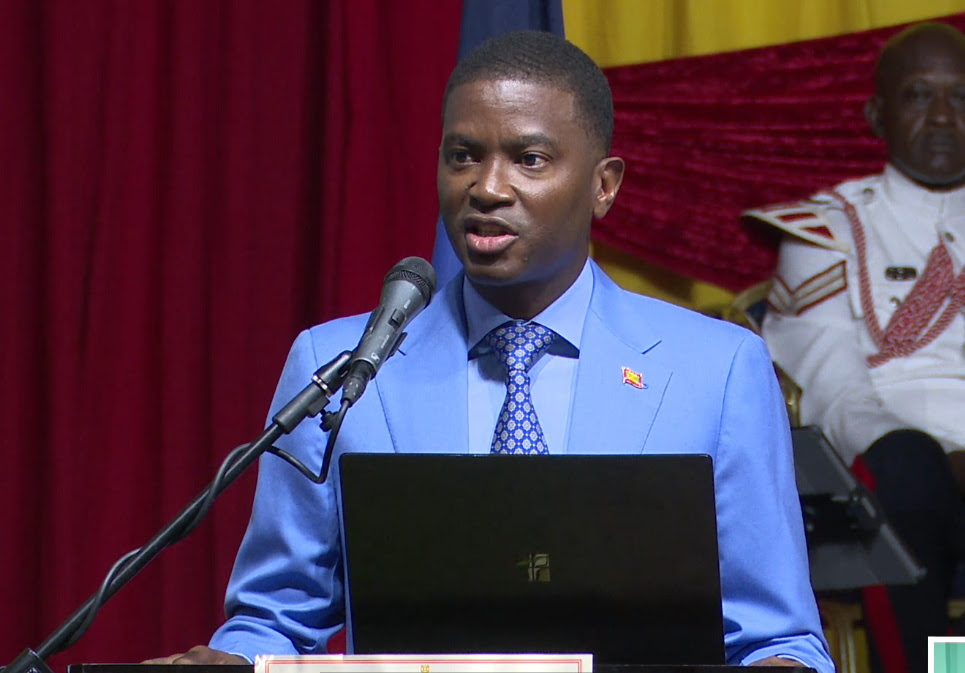
ST. GEORGE’S, Grenada, Nov 16, CMC – Prime Minister Dickon Mitchell Monday warned his newly sworn-in 15-member Cabinet that while Grenadians expect “we will not always get everything right,” he expects them never to lose sight of the fundamental reason we have been entrusted with the responsibility to govern.
Mitchell led his National Democratic Congress (NDC) to a second consecutive term in office on November 5 by winning 14 of the 15 seats in the general election he called almost one year ahead of the constitutional deadline. In the last general election held on June 23, 2022, Mitchell led the party into the corridors of power after nine years in the political wilderness by winning nine of the 15 seats, defeating the New National Party (NNP) that had controlled all 15 seats in the Parliament.
In the general election earlier this month, the NNP won just one seat.
Speaking after the members of the new look Cabinet were sworn into office by Governor General, Dame Cécile La Grenade, Prime Minister Mitchell said that the “true measure of this cabinet will not be found in this ceremony.
“So to my cabinet colleagues, I remind us that we should lead with humility and that we must work with urgency,” Mitchell said, adding, “we must deliver with purpose.
“So to our citizens of Grenada, Carriacou and Petite Martinique, I say to you on behalf of the cabinet of ministers that our commitment to you remains unwavering. Yes, we will not always get everything right.
“There will be challenges. There will be difficult decisions, and there will be moments when progress seems slower than we would have wished. But I give you this assurance: we will remain focused. We will remain accountable. We will remain determined, and we will never lose sight of the fundamental reason we have been entrusted with the responsibility to govern,” Mitchell said.
He reminded the ministers that the fundamental reason is to serve the people, adding that “the time for political competition has passed. The time for national development requires you, me, us,” he added.
Mitchell said he has realigned his new Cabinet to deal with a changing domestic and global environment, with former Attorney General, Claudette Joseph, now responsible for the Ministry of Petroleum, Hydrocarbon, Constituency Affairs and Community Development, while the former ambassador to the United States, Tarli Francis, is the new Minister of Foreign Affairs and Export Development.
Delma Thomas has been appointed the Minister of Family, Social Affairs, Wellness and Religious Affairs. With Afri Ventour as the Attorney General and Minister of Legal Affairs and Justice. Former finance minister Dennis Conwell is the new Minister for National Security, Home Affairs, and Disaster Management.
Mitchell said that the continuing task is to translate the confidence of the people into meaningful improvements in their daily lives and the new Cabinet “is designed for the work ahead.
“Today, we have presented a Cabinet deliberately designed to meet the demands of this new phase of national development,” he said, noting that in making the appointments, he had been guided by three fundamental considerations, namely the competence and the capacity required to govern effectively, the need to distribute responsibility and strengthen accountability and the importance of building a government capable of delivering on the country’s long-term national transformation agenda.
“And therefore, the size and the composition of the cabinet is deliberate. We have chosen to appoint a relatively broad ministerial team due to the magnitude of the responsibilities that…this government must discharge.
“Grenada today and Grenada in the future faces and will face a far more complex development environment than it did a generation ago. We must transform our education system, strengthen healthcare, modernise public administration, build climate-resilient infrastructure, achieve greater food and energy security, create meaningful opportunities for our young people, and position our economy to compete in a rapidly changing world.”
Mitchell said that these responsibilities cannot be approached casually, nor should they be concentrated in the hands of a small number of individuals who are expected to supervise several major sectors simultaneously.
“Our approach is to ensure that ministers have clearly defined responsibilities, sufficient time to engage with their respective sectors, and the ability to provide sustained leadership. A broader distribution of ministerial responsibilities offers several important advantages. It allows for greater specialisation.
“It enables more effective oversight of government departments and programmes. It improves responsiveness to the concerns of our citizens, and it provides opportunities to develop a deeper pool of national leadership. And, importantly, it reduces the risk of critical national priorities being neglected because a minister is overwhelmed by competing responsibilities.”
But Mitchell said he wanted to be “equally clear” that a larger cabinet “must never become an excuse for a larger bureaucracy, unnecessary expenditure, or inefficiency.
“Every minister must justify the confidence placed in them through performance. Each ministry must demonstrate value for money. Each government programme must have a clear purpose. Each minister must understand that public office is not a reward; it is a responsibility.
“We will judge ourselves by how effectively the ministers improve the lives of the people we serve,” he said, adding that some of the individuals appointed to ministerial office were not candidates in the general election.
“This arrangement recognises an important principle. The talent required to develop a nation is not confined to those who contest elections. Elections determine who receives the democratic mandate to govern. But effective governance also requires technical expertise, professional experience, institutional knowledge, sound judgement, and the capacity to manage complex national challenges.”
But Mitchell said that they are all Grenadians who have devoted their lives to public service, to law, to business, to education, to technology, to community development, and other fields who may not wish to pursue electoral politics, but who are nevertheless willing and able to serve their country.
“And therefore, we must create the opportunity for such persons to contribute,” he said, adding that he will be appointing three senators, “and in giving them ministerial appointments, we are doing just that.
“In selecting the members of the cabinet, I have sought to combine the democratic legitimacy of our elected representatives with the professional expertise and perspectives of other capable citizens,” Mitchell said, insisting “this is not a departure from democracy.
“It is an opportunity to strengthen the quality of democratic governance, and I emphasise (8:54) that the persons who enter government through the Senate will be held to the same standards of accountability, integrity, discipline, and performance as those who enter through the ballot box. No minister is above scrutiny,” Mitchell added.
CMC/jg/ir/2026