



By Staff Writer
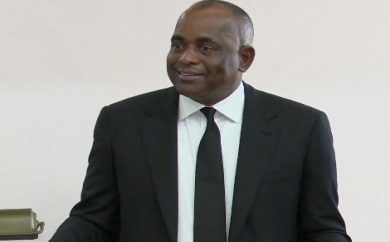
ROSEAU, Dominica, Apr 10, CMC – Prime Minister Roosevelt Skerrit Friday said that the consequences of the ongoing Middle East conflict involving the United States, Israel, and Iran are translating into higher prices for food, fuel, and other essential goods for small countries like Dominica.
In a statement to Parliament in which his administration gained approval to extend key fiscal measures aimed at easing the rising cost of food and essential goods, Skerrit told legislators that the world has been confronted with a “grave and unfolding conflict” which, though distant from our shores, has consequences that are not distant from our people.
“Global oil prices have surged, supply chains have been disrupted, and the cost of transporting goods has risen sharply. These pressures are now being felt across economies large and small, with inflationary effects reaching even the most vulnerable countries.”
Skerrit said that for small, import-dependent states such as Dominica, these external shocks translate directly into higher prices for food, fuel, and other essential goods.
“We are, in many ways, innocent bystanders affected by a conflict not of our making – but we must not be passive in protecting our citizens from its consequences,” he told legislators, noting that late last month the government committed to a series of targeted relief measures. “Today, we deliver on one of those measures. We are extending the waiver of Value Added Tax (VAT) and import duties on a range of essential goods until July 2026,” Skerrit said, reiterating, “these are difficult times.
“Global forces threaten to erode the purchasing power of our citizens, so the government is taking decisive action to stabilize the cost of living for all citizens. Families have challenges in meeting the rising cost of necessities, so this government is acting with urgency and empathy”.
Skerrit said that the government was adopting the policy at a time of harsh criticism from opposition forces, based on “their adverse inferences” from the March 2026 Article IV Report of the International Monetary Fund (IMF) regarding the government’s fiscal performance.
Skerrit said that the IMF report had indicated that real gross domestic product (GDP) growth accelerated to 4.5 per cent last year from 3.5 per cent in 2024, supported by robust tourism and targeted development investments.
He said that the Washington-based financial institution had indicated that inflation continued to ease, averaging 2.3 per cent in 2025, and that the current account deficit remained elevated, primarily reflecting high construction-related imports.
Skerrit said that real GDP growth is projected to average three per cent in 2026–27, supported by continued strategic investment in flagship infrastructure projects, before gradually slowing to around two per cent as construction winds down.
He said the current account deficit is expected to return to normal on the back of stronger tourism, a normalisation of investment-related imports, and lower energy-related fuel import needs accompanying the transition to geothermal energy.
He said the IMF noted that overall risks to the outlook are elevated and tilted to the downside, driven by spillovers from the war in the Middle East, heightened geopolitical and trade tensions, uncertainty surrounding CBI inflows, and persistent natural-disaster threats.
“Mr. Speaker, despite recent challenges, our economy is expanding, inflation is easing, and our investments are yielding results. While the current account deficit remains elevated, the IMF attributes this primarily to the robust execution of our macro-critical projects.
“None of these downside risks to the IMF economic outlook – Middle East war, heightened geopolitical tensions, uncertain CBI inflows, and natural disaster threats – are within the control of the government and people of Dominica.”
Skerrit said that in reviewing these IMF and other reports on the state of Dominica’s economy, critics make heavy weather of the primary balance benchmark as an indicator that all is not well.
But Skerrit said he is presenting to Parliament what he hopes “will be a clear and practical understanding of the concept of the primary balance, its current trajectory in Dominica, and its implications for fiscal policy and decision-making in the mold of what is currently before the country.
He said that in recent years, Dominica’s fiscal position has been shaped by hurricane recovery, climate resilience investments, the COVID-19 pandemic, and global inflationary pressures.
“As a result, the country experienced significant primary deficits, averaging approximately 4.3 per cent of GDP in the immediate post-crisis period. These deficits have been gradually reduced through improved revenue performance, expenditure management, and fiscal discipline.
“Consequently, Mr. Speaker, thanks to our deliberate policy of fiscal consolidation, Dominica, according to the IMF 2026 article 4 report, is now in a primary surplus position of 0.7 percent of GDP or 14.7 million. “
Skerrit said that the IMF recommends that Dominica hit a primary surplus target of 3.4 per cent of GDP…by 2027/28 and sustain it over the medium term to reduce debt to safer levels, strengthen fiscal resilience, and accumulate 12 per cent of GDP in contingent self-insurance against disaster events.
“But let us all be clear, achieving and maintaining a healthy primary surplus requires careful policy choices. Like raising revenue through additional taxation and/or enforcement of compliance with tax responsibilities, like controlling recurrent expenditure, and prioritising capital investment.”
But he acknowledged that the government must simultaneously promote economic growth, support vulnerable households, respond to rising global prices, invest in infrastructure, and climate resilience.
He said this creates an inherent policy tension between fiscal discipline on one hand and meeting social and economic development needs on the other.
“Measures such as VAT and duty waivers on essential goods are designed to ease the cost-of-living burden and protect citizens during periods of economic stress. While these measures provide immediate relief to households, they also reduce government revenue in the short term and may affect the pace at which a primary surplus is achieved.”
Skerrit said that the government is making steady progress in the responsible, sustainable, people-centered management of the nation’s finances and that maintaining this trajectory will require continued discipline, strategic prioritization, and a balanced approach that safeguards both economic stability and the welfare of our people.
“This cost-of-living relief initiative before us today is therefore about people. It is about the single mother trying to put food on the table. It is about the elderly pensioner managing a fixed income. It is about the working family whose wages have not kept pace with global price shocks.”
Skerrit said that by removing these taxes on essential goods, the government is easing the cost of living, protecting household incomes, and ensuring that necessities remain within reach.
“This government cannot control wars abroad, nor can we dictate global commodity prices. But we can control how we respond. And our response will always be guided by one principle – to look out for our people, especially in times of hardship.”
He said that in extending this relief, “we reaffirm our commitment to stand with the people – not only in times of stability, but more importantly, in times of uncertainty.
“Because ultimately, the strength of a nation is measured not only by economic indicators disclosed in IMF or other reports…but by how well it protects and uplifts its people in times of greatest need.”
CMC/kf/ir/2026