



By Staff Writer
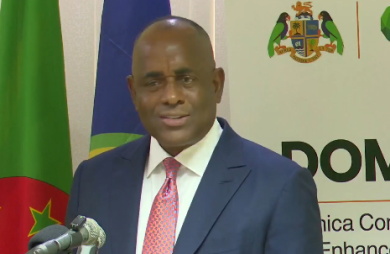
ROSEAU, Dominica, Jun 3, CMC –Prime Minister Roosevelt Skerrit Wednesday launched the multi-million dollar Dominica Community Resilience Enhancement Project (DOMCREP), noting that the climatic condition in the world has changed dramatically and is having a “tremendous negative impact” on countries.
DOMCREP is a US$25 million Green Climate Fund (GCF) investment and the first single-country GCF project in Dominica. The project’s largest investment, approximately US$17.5 million, will be directed toward climate-resilient livelihoods. More than 520 farmers and agro-processors will receive support for climate-smart technologies, irrigation systems, agroforestry, greenhouse infrastructure, and agro-processing rehabilitation.
Eight communities will directly benefit from this project, communities that have already borne the impacts of major climate events and whose voices and experiences have helped shape the design of this project.
“We in Dominica and the Caribbean, we are not major contributors to carbon emissions. We’re not the cause of the problem. The causes of the problem reside in industrialized and developed countries,” Skerrit told the launch, which was also addressed by the executive director of the Belize-based Caribbean Community Climate Change Centre (CCCCC), Dr. Colin Young.
Skerrit said that while those countries have a “responsibility and duty” to address the problem, which is an existential threat to every nation,” sometimes he does not believe that the Caribbean society, whether it’s the private sector, unions, or citizens, understands and appreciates “how climate change is impacting our economic and social development”.
He said in Dominica’s case, about 85 per cent of the national debt is associated with disaster response or shock, recalling that earlier this year, the government had to pay out more than EC$4.6 million (One EC dollar=US$0.37 cents) just clearing landslides.
“ We in Dominica, we were saving to pay off our national debt. And I wanted Dominica to be the first developing country in the world to owe nobody and to owe no country. And as a matter of fact, before the hurricane in September, I was formulating in my mind what the independence speech would have been in 2017.”
He said he had intended to inform the nation he had a strategy in place to save money “to pay off our national debt and to be the first country to have a zero per cent debt to GDP ratio and what we’re going to do was to create an economic diversification fund and and pay into this fund as if we were still owing and use this as a source of revenue”.
But he told the ceremony that following the passage of the hurricane in 2017, the Dominican economy was affected by successive hurricanes, resulting in damage estimated at 226 percent of the GDP.
“For a country to be hit in such close succession and to the extent that it was hit, we can only thank God that we’re alive today as a country. And I will say to my friends and to those listening that in these two events, I never asked any country for debt forgiveness.
“I never asked any country to defer the payments of debt. As a matter of fact, our quarterly payment from some loans we had to the World Bank was supposed to have been made at the end of September, and we paid that to the World Bank at the end of September in 2017.”
He said that the creditors were shocked that Dominica was able to pay, considering the extent of the damage, noting, “I felt that at any material time people must keep their word, and we wanted to keep our word and keep our legal obligation.
“ I believe that the developing world must understand and appreciate …that we in the Caribbean, if given opportunity, we have the capacity to implement our projects and our programmes, our strategic plans or our national plans.”
He said that the case Dominica has been making is that the CCCCC is a responsible institution “with clear goals and mission and with a very profound depth of capacity and knowledge and skills that we don’t have to go to the Green Climate Fund for the funds.
“The funds should be with the 5C’s. The 5C should have the funds. The funds should be deposited with the 5C’s, so that the project is conceptualized nationally with the help of the 5C technical …,” he added.
Skerrit said that Dominica has long respected the environment and has been at the forefront of protecting the environment, but the developed world, “with their recklessness and indifference is causing tremendous hardship for us.
“This is not a time for anybody to say sorry to us. This is a time for people to recognize that they’re causing pain and suffering to people. People who have no other means of challenging them and no means of enforcing even the recent adjudication or the opinion have no legal effect, and even about the Paris Accord”.
Skerrit recalled that when the Paris Accord was adopted in December 2015, he maintained “that unless this agreement is legally binding, it is not worth the paper it is written on, and so it is easy for any country to remove itself because there’s no legal obligation.
He said that the Kyoto Protocol adopted in 1997 contained “promises” made to developing countries and “never fulfilled, and so forth, and so we have to respond to the disasters and the sheer cost of disasters largely on our own”.
In his address, Young described DOMCREP as a “tangible and significant investment in the building of climate resilience” for Dominica, as well as reflecting “the power of partnership, shared vision, and sustained commitment.
“The DOMCREP project we are launching today represents years of technical work, stakeholder engagement, and collaboration. Following extensive consultations, assessments, and project design, DOMCREP received Green Climate Fund approval in October 2025 and became effective in March 2026.”
Young said that the launch marks the transition from planning to implementation of a shared vision for a more resilient Dominica.
He said climate-related disasters have taught an important lesson in that resilience cannot be built after a disaster strikes.
“It must be strengthened beforehand. For Small Island Developing States like Dominica, climate resilience is not separate from development—it is essential to protecting lives and livelihoods, food security, economic stability, and the well-being of future generations.”
Young said that this message speaks directly to the purpose of the project.
“DOMCREP recognizes that climate resilience is not only about protecting against future hazards; it is also about protecting lives today, strengthening livelihoods, supporting economic opportunity, and improving the quality of life for communities today, particularly among the most vulnerable.
“DOMCREP …is an investment not only in resilience, but in Dominica’s future—a future where communities are better prepared, livelihoods are more secure and resilient, and where development gains can be sustained for generations to come.”
He said DOMCREP will also strengthen early warning systems, emergency shelters, and disaster preparedness, while supporting the policies, data systems, and institutional capacity needed to sustain resilience long after the project concludes.
Ultimately, the success of this project will be measured not by budgets or outputs, but by the difference it makes in people’s lives.
By 2030, DOMCREP is expected to reduce recovery times for food production by 50 percent following climate-related disasters, enabling farming communities to return to production more quickly and strengthening food security.
Young said the project will contribute to greater water security through a 30 percent increase in communal water storage capacity in rural districts and will support more inclusive economic opportunities through its matching grant programme, with at least 40 percent of grants awarded to female-led enterprises.
More than 8,300 people are expected to benefit directly from this project, with positive impacts extending across communities throughout Dominica.
CMC/cj/ir/2026