
By Staff Writer
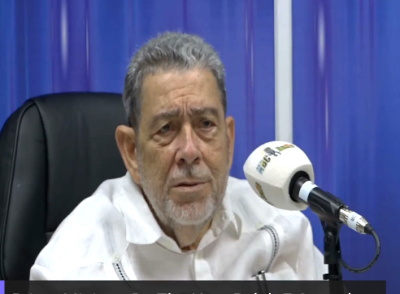
CASTRIES, St. Lucia, Oct 12, CMC – Former St. Vincent and the Grenadines prime minister Dr. Ralph Gonsalves Monday said that St. Lucia’s journey since attaining universal adult suffrage 75 years ago “has not been without its immense challenges”.
Addressing a special sitting of the St. Lucia Parliament to mark the occasion, Gonsalves, who up until November last year was among the longest-serving heads of government in the Caribbean Community (CARICOM), said that the challenges have been magnified given the inherent vulnerabilities and the ill winds that have come to the Caribbean from the existential threats of climate change, the contradictions and burdens arising from the global political economy, and the rollercoaster consequences of a revised United States Monroe Doctrine of 1823.
He said that includes the Donald Trump corollary “in a quest for an unquestioned hegemony of the United States of America in our hemisphere”.
Gonsalves, an attorney and a former University of the West Indies (UWI) lecturer in political science, said that St. Lucia and other Caribbean countries “cannot and would not roll over and play dead in the face of neo-imperial impositions from near or far.
“To be sure, as principled and practical people, we in the Caribbean know that we cannot lift our countries and take them to Vladivostok or to the mouth of the Amur River. We are where we are physically.
“So do the United States of America. Geography, history and contemporary circumstances have conjoined us, the United States and the Caribbean. So in continued pursuance of the evolution of our popular-based social democratic revolution in a difficult era, we must, in our own interests, come to terms with the extant challenges of the external political economy, including those arising from our relations with the USA today.
“Clearly, it is infantile and wise and unproductive for the social democratic and anti-imperialist forces in our Caribbean, including in St. Lucia, to adopt a knee-jerk, perpetually instinctive opposition to the USA and its government.”
But Gonsalves said that “at the same time, we cannot roll over and play dead between these two polar opposites of infantile oppositionism and rolling over and playing dead between those two polar positions.
“There is a range of options and engagements to be pursued with the USA through mature conversations and efficacious endeavours. In this sensible way, the social democratic revolution will roll on with its objective interests popularly based.
“In this process, solidarity and unity of the people are to be our constant watchwords. It is evident, too, that the extant external challenges are so huge that they can only be addressed through an encompassing multilateralism and appropriately targeted bilateral relations, inclusive of the pursuit of a many-sided coordination of foreign policy through the OECS (Organisation of Eastern Caribbean States), CARICOM (Caribbean Community), and possibly CELAC (Community of Latin American and Caribbean States).
Gonsalves said that these external challenges to the solidity and success of the social democratic revolution and the people’s well-being range over a gamut of issues, including the existential threat of climate change, the unequal yoking of developing countries like St. Lucia, the global financial architecture and the urgent requirement for fundamental reforms.
Gonsalves said that there is also the need for appropriate levels and favourable conditions of climate financing, the threats of nuclear war and the use of other weapons of mass destruction, the possibilities and dangers to humanity of artificial intelligence, and the necessity and desirability of effective regulation.
He said that the challenges arising from the extant contradictions of global monopoly capitalism, the debilitating fallout from the competition for hegemony by the great powers, the need for reform of the United Nations and allied institutions to better serve vulnerable and marginalised countries, and the pursuit of the 17 Sustainable Development Goals in partnership with developed and emerging economies.
“I reiterate, none of these fundamental questions touching on concerning life, living, and production thrown up by the social democratic revolution can be addressed unilaterally,” Gonsalves said, adding that regional, hemispheric, and global cooperation is vital.
He said one other critical issue on the contemporary political agenda for the social democratic revolution is that of reparations for native genocide and the enslavement of African bodies.
He said the St. Lucia-born Nobel Laureate Sir Arthur Lewis as well as the Jamaican Pan-Africanist Marcus Mosiah Garvey had flagged it, and that it is on the agenda.
He said CARICOM, the African Union, Global Africa, and “our allies in this great cause globally rightly view reparatory justice from the relevant European nation-states as a matter of international justice.
“After the path-breaking resolution adopted overwhelmingly by the United Nations General Assembly on March 25, 2026, in which the Atlantic slave trade and racialised chattel slavery were declared to be the greatest crime against humanity, thus international justice, justice for us, demands reparations.”
Gonsalves said that the leadership role of St. Lucia and Prime Minister Philip J. Pierre has been critical in this struggle for reparatory justice.
“This is an issue whose time has now come. I look forward to the advances in this regard at the Commonwealth Heads of Government meeting scheduled for Antigua and Barbuda on November 1,” Gonsalves added.
He said he is “hugely impressed” by the post-independence efforts of successive governments in St. Lucia, particularly those grounded in the ethos of the social democratic revolution, to fashion and implement a modern, competitive, many-sided post-colonial economy that is at once national, regional, and global.
“Each limb of this quest is pregnant with real practical meaning. A strong post-colonial economy of shared prosperity is the material foundation for marked improvement in people’s lives and living.”
Gonsalves said that the crafting and implementation of the post-colonial economy in St. Lucia have met and still do meet many enormous challenges, both internal and external, and it has not been easy in addressing them.
“Thus, progress has been uneven, but the trajectory has been that of upliftment and advancement markedly in material terms. Economic growth and human development have been evident, though immense difficulties remain,” said Gonsalves, who had traced the start of the issues that eventually led to adult universal suffrage 75 years ago.
He said that the social democratic forces unleashed in the 1930s and channeled into popular democracy, sovereignty, independence, good governance, institutions, regional and international solidarity, have repeatedly met these encumbrances to development with measured yet evident successes.
“The dialectics of this progressive forward march in St. Lucia are complicated and demand, among other things, a people-centred vision, a coherent philosophy of advanced social democracy, an appropriately devised priority bundle of policies and programmes, a practical matching of available resources to implementable actions for sustainable development, sound governance and political institutions, regional and international solidarity and engaged and committed population and quality leadership.”
Gonsalves said that these compelling issues and more were presented to St. Lucians by Prime Minister Pierre in the national budget address this year, adding, “It is essential reading for those determined to advance further the ideals of the ongoing social-democratic revolution, which had compelling strategic staging posts of universal adult suffrage in 1951 and the reclamation of national independence in 1979.
Gonsalves said that the constellation of factors confronting the further advance of social-democratic revolution in its current phase demands, “I reiterate, a national and regional unity on the fundamentals of life and living and production and governance as never before.
“I tell you this, our margin for error is very slim, and I know a lot of people like to take chances. I always say, you want to take a chance, you play the lotto. This matter is a matter that people have to reflect on seriously all the time.
“There’s not a big margin for error, and the problems and challenges are enormous. But we have possibilities and strengths, as I’ve indicated. Politics is serious business for serious people. It is not a branch of an expanding entertainment industry
“A society of quality and shared prosperity cannot be built on laziness, indiscipline, and pervasive crimes of violence. A sustainable social democracy cannot be shaped by excessive pleasure, leisure, and nice time. I’m all in favour of those things, but these activities have to be paid for by productive labour, and you can’t really want to have excessive pleasure, leisure, and nice time, and don’t want to work productively to be able to afford these things”
Gonsalves said that these are truisms “bequeathed to us by our forebears” and are not ideological propositions.
“These are truisms bequeathed to us by our forebears from the generation of universal adult suffrage. They remain more relevant today than ever before. And above all, we must continue to reaffirm that our Caribbean nations are founded on the belief in the supremacy of God and the freedom and dignity of man and woman,” Gonsalves told the special sitting of Parliament here
CMC/pr/ir/2026