
By Staff Writer
CASTRIES, St. Lucia, Aug 24, CMC – The 15-member Caribbean Community (CARICOM) grouping has employed the services of a regional law firm to present its response to the challenge by Trinidad and Tobago’s Prime Minister Kamla Persad-Bissessar regarding the reappointment of CARICOM Secretary General, Dr. Carla Barnett.
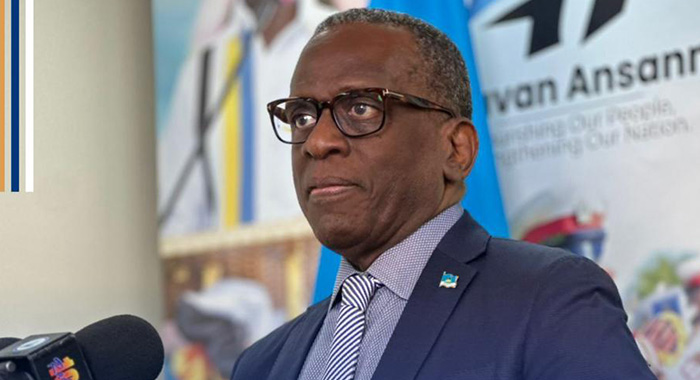
CARICOM chairman and St. Lucia’s Prime Minister Phillip J Pierre told a news conference on Monday that his recent visit to Port of Spain, where he met with Prime Minister Persad-Bissessar, was “very cordial.
‘Basically, the Prime Minister wanted an update. I went to give an update on the advisory opinion … and what was the state of play on the opinion that the government of Trinidad and Tobago requested on the appointment of the Secretary-General of CARICOM.
“As you know, the government of Trinidad and Tobago agreed that they wanted an advisory opinion from the Caribbean Court of Justice (CCJ) on the appointment of the Secretary-General. So we went to update each other. I updated her as to where we were as CARICOM, and she updated me as to what the government of Trinidad and Tobago was doing in terms of asking for that opinion. It was a very cordial meeting,” Pierre told reporters.
Pierre said that Trinidad and Tobago has prepared its position “and CARICOM will review it through its Counsel, and I want to tell you that the Secretary-General of CARICOM and the Counsel of CARICOM have excused themselves from the process.
“They’re not involved in the process at all. Neither the Secretary-General of CARICOM nor the Counsel of CARICOM is involved in the process. The process has been handled by external counsel.
“CARICOM has employed external counsel, so we want to ensure that the whole process is transparent. So CARICOM’s Secretary-General is not involved, nor is the Counsel of CARICOM involved either.”
He said where the parties are now is that the external counsel that CARICOM has employed “has all the documents, all the precedents as it relates to the appointment of Secretary-General and the Trinidad and Tobago government will present its case to the judges”.
He did not indicate when that would occur.
CARICOM leaders at their summit in St. Lucia last month had agreed to seek an advisory opinion from the CCJ after both Trinidad and Tobago and Jamaica had written to them regarding the procedure used on re-appointing Barnett, the first woman to ever hold the post of CARICOM Secretary General.
Trinidad and Tobago said then that its objection to the reappointment of “is neither personal nor political” and in her 22-page letter to the regional leaders, Prime Minister Persad Bissessar also noted that Port of Spain’s position “is not directed towards any individual,” but rather “ it concerns the legality of the process adopted, the integrity of our institutions and the faithful observance of the constitutional framework established by the Revised Treaty of Chaguaramas”.
She said that her administration “does not accept the process by which the Secretary-General was purportedly reappointed, and consequently, is unable to recognise the validity of the purported second term of the Secretary-General.
“I wish to be very clear: our position is not held to create division within the Community, but to preserve the constitutional order upon which the legitimacy and credibility of CARICOM ultimately depends.
“Regional unity cannot rest upon expediency and irregular practices masquerading as precedent. It must rest upon adherence to the rules which every Member State has freely accepted and undertaken to uphold,” Persad-Bissessar wrote in her letter.
Late last month, the Trinidad-based CCJ said it was not in receipt of any official request for an advisory opinion from CARICOM regarding the re-appointment of Barnett.
“While the Court is not yet in receipt of any official request for an Advisory Opinion from CARICOM, it takes note of the information in the public domain that such a request may be forthcoming,” the CCJ said.
The CCJ said that within 14 days of receipt of a request for an Advisory Opinion, the Registrar of the Court shall serve copies of the request on all member states and the Secretary General of CARICOM.
“Any entity which has been served shall be entitled to make written submissions to the CCJ within 42 days of being served,” it said, adding that “in accordance with its internal procedures, an Advisory Opinion will ordinarily be issued no later than six (6) months after the hearing”.
Pierre told reporters that Prime Minister Persad-Bissessar, who has had a rocky relationship with the 15-member-regional integration grouping since her party was returned to government in April last year after a 10-year absence, “reaffirmed her belief in CARICOM.
“So I was very pleased that she did that. So we’re looking forward to working together,” he said, adding, “as you know, CARICOM doesn’t have a unified external affairs policy, it never had,” Pierre said, adding that he expects each CARICOM country to deal with its own external affairs.
CMC/pr/ir/2026