
By Staff Writer
ST. GEORGE’S, Grenada, Oct 29, CMC – Former Grenada foreign affairs minister, Peter David, has expressed disappointment at the divided positions adopted by Caribbean Community (CARICOM) countries regarding a Cuba resolution tabled at the United Nations condemning the decades-old United States trade and economic embargo against Havana.
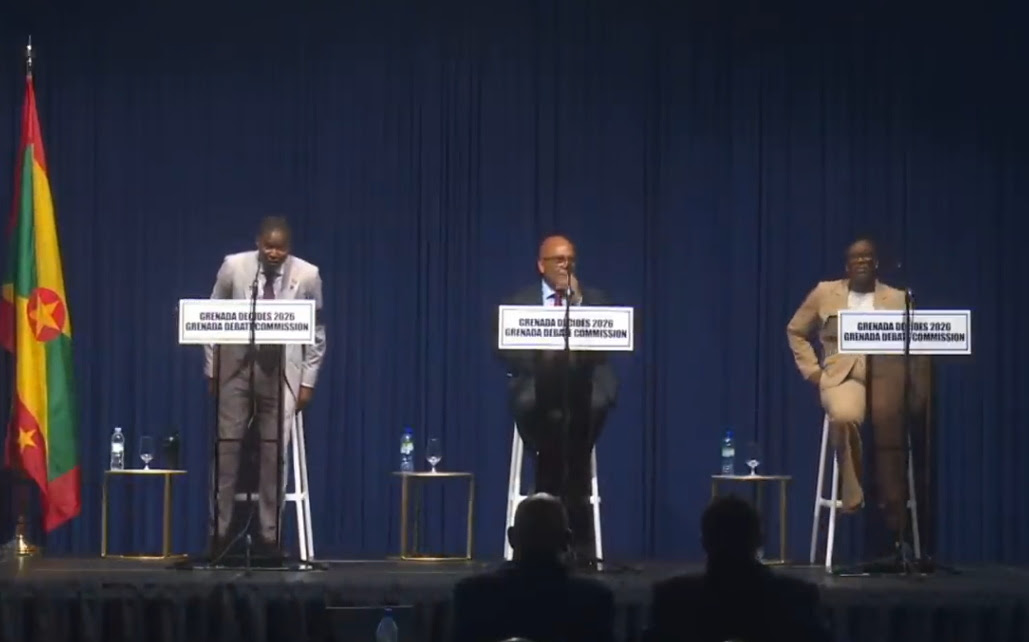
“I think all of Grenada is extremely grateful to the government and people of Cuba for all the assistance over the years and I want to say it here tonight that we continue to be grateful and we’ll do everything to preserve our relationship with the government and people of Cuba,” David said as he participated in the first-ever “National Leaders Debate” ahead of the November 5 general election here.
David served as foreign ministers between the years 2008 to November 2010 and March 2018 to September 2020.
Prime Minister Dickon Mitchell, who is leading the ruling National Democratic Congress (NDC), and Emmalin Pierre, the first woman to lead the main opposition New National Party (NNP) into a general election, also participated in the debate that was organised by Media Workers Association of Grenada (MWAG), Grenada Broadcasting Network (GBN), The Bubb Report and the Grenada Conference of Churches.
Trinidad and Tobago became the first Caribbean Community (CARICOM) country in decades to ever have voted against the resolution, but while the Cuban government may have been pleased with the outcome of the vote, Havana lost significant support from countries in the Western Hemisphere and Europe.
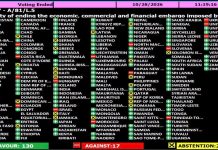
The resolution passed 130-17, with 25 abstentions, a sharp drop from last year, when it won 165 votes, with seven against and 12 abstentions.
Of the CARICOM countries that were present at Wednesday’s debate, Jamaica, Haiti and Guyana abstained, while Trinidad and Tobago voted against. The Bahamas, Belize, Barbados, Grenada, St. Vincent and the Grenadines, St. Kitts and Nevis and Suriname all voted in favour of the resolution, while Antigua and Barbuda, and Dominica and St. Lucia were marked as being absent when the vote was taken.
Jamaica’s Foreign Affairs and Foreign Trade Minister, Kamina Johnson-Smith, told a news conference that Kingston had been reflecting on the UN vote for some time, “as this is a shift in policy”.
Prime Minister Micthell was more diplomatic in his response, saying Grenada’s foreign policy is based on “putting the people of Grenada first.
“We cannot hypothetically engage in diplomacy. So whether it’s Cuba, or Africa, or Venezuela, or the United States, or the European Union, or the United Kingdom, on any given day, multiple competing diplomatic issues are being thrown at you.
“And therefore, we assess all of this and decide on any given issue, a particular vote, a request for support here, permission to not support a particular issue, based on what is before us and what would be in the best interests of Grenada,” Mitchell said, telling the debate, “as Prime Minister, I will never conduct foreign diplomacy in public or in the media”.
Mitchell said that, for example, Grenada “will do everything to preserve visa access to the United States,” noting that the only country, however, that can give you access to the United States is the United States.
“And therefore, in our dealings with the United States, we will do everything without compromising our sovereignty to ensure that Grenadians may be able to get access to the United States.
“But at the end of the day, for example, the United States will determine whether or not it grants you access and the conditions on which it grants you access. Those conditions may sometimes require you to agree or not agree to things that you may not want to agree to. And that is where the negotiation takes place. “
While he did not make direct reference to the UN vote on Cuba, Mitchell told the debate, “If there’s a vote against reparations at the UN, for example, you need to vote no, but you will not get visa access.
“We will then have to have the conversation as to whether visa access is more important or whether a principle stands against reparations is more important. And that may involve discussions with the Grenadian public, or it may require hard decisions about leadership and what we as a nation stand for and represent.
“And that is what the discussion is about, putting the interests of Grenadians first,” he said, adding, “it could be trade. It could be principles of voting at the UN on any given matter. And this is what we have to understand about diplomacy. “
David, who is leading the recently formed Democratic People’s Movement (DPM) into the election, told the debate that while Grenada’s support for Cuba should not result in “threatening our relationship with other allies,” CARICOM countries “without exception” had traditionally voted against the embargo.
“What has happened now is that there are some Caribbean islands that have decided to abstain, some voted against, Trinidad voted with Israel and the United States, so there seems to be a fracture in the Caribbean, and I want to make this point, and this is what I’m leading to, that we need strong diplomacy regionally, and I think that is a tragedy that has taken place, that regionally, our countries are fracturing in their positions.
“I think one of the reasons for CARICOM was to try to get a unified position on international relations and on diplomacy, but we failed to do that, so some countries are going this way, others are going that way, and we find ourselves divided, facing the world,” David said.
For her part, Pierre said that the vote by CARICOM at the UN was “very unfortunate,” adding that “it’s really sad that CARICOM was so divided on one single matter that we’ve been united on in the past, and I would say that as leaders of this country, we have to commit to ensuring that we are supportive of a united region”.
She is promising that as “the next Prime Minister of Grenada, I am committing that we are going to support and do everything possible to promote unity within the region that can have a positive effect for our individual countries”.
Pierre said that Grenada has always enjoyed “a very good relationship with the United States of America, with Cuba, with Venezuela,” adding that in diplomacy, there’s no absolute need to choose one over the other.
“And I believe what is necessary is strategic diplomacy. At the end of the day, what is necessary is that there is conversation at the highest level, negotiation that is fruitful, and negotiation that is in the interest of the people.
“I believe at the end of the day, we have what it takes as a nation to maintain good relationships with all of our friends without creating unnecessary enemies,” she added.
CMC/pr/ir/2026