
By Staff Writer
ROSEAU, Dominica, Aug 7, CMC – Prominent Dominican businessman, Gregor Nassief, Friday left open the option of taking legal action to force the government to address what he has described as “disturbing” issues within the Citizenship by Investment (CBI) programme.
Under the CBI programme, Dominica provides citizenship to foreign investors in return for making a substantial investment in the island’s socio-economic development.
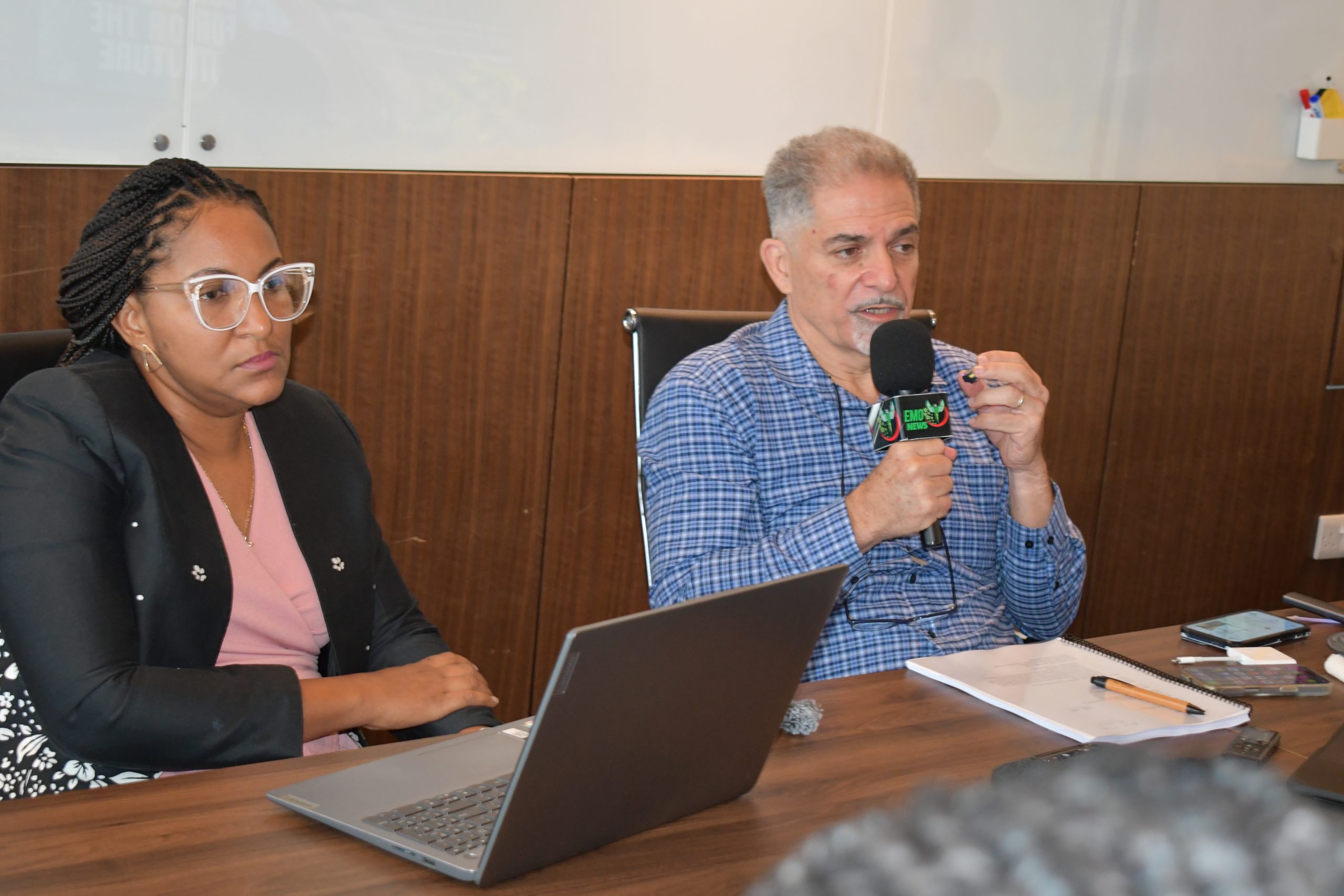
“You know, the court is there. The court is always there for redress,” Nassief, a hotelier and investor in the CBI programme, told a news conference, flanked by his attorney, Noelize Knight Didier.
“I tell people that all the time, constitutional actions, judicial review actions, the courts are always there, and that is what will be there for Secret Bay (resort) …but the first course would be and what we would like to do is to Petition the President ( Sylvanie Burton) to establish a Commission of Inquiry ….(that) really would be a very suitable way to deal with this,” the attorney added.
She said that an independent commission should be established to “look at what has been going on, get those forensic audits that Mr. Nassief was speaking about and really …get to the bottom of this and figure out what is going on”.
Earlier this week, Nassief released to the public a letter he had sent to Prime Minister Roosevelt Skerrit and Opposition Leader Jesma Paul-Victor in June, after the document was leaked and began circulating widely on social media.
He told reporters that he was not being “naive” into thinking that the June 17, 2026 letter would not have been leaked given that it was copied to several other people including Cabinet ministers, parliamentarians, President Sylvanie Burton, the Financial Intelligence Unit (FIU) and the Citizenship by Investment Unit (CBIU).
“But I was certainly clear there was a risk the letter could be leaked. But please understand that I’ve been writing for seven years, 14 letters, and I have not been writing to one person. I’ve copied this to the Minister of Finance, the AG, and the …the President’s office, and I was getting no response.
“And so I thought that the logical next step was to involve Parliament in this. This is a very serious issue. So they were copied, and certainly there was a risk the letter would have been leaked. It’s always a risk.”
Both Nassief and his attorney acknowledged that the main opposition United Workers Party (UWP) has before the courts here an issue regarding the CBI, with Knight Didier saying “there is a matter before the court right now about where the CBI funds are being directed…
“I think that the claim or the complaints really is that a lot of the CBI funds are not getting into the Consolidated Fund…and what Mr. Nassief is bringing to the floor today, it is similar but different.
“It’s a different issue…to do with the CBI programme and the funds of the CBI programme, but it is dealing specifically with the discounting of the citizenship and the effect of that on other persons involved in the programme and the effect on the Treasury,” the attorney said, adding that “but I think what both matters raise is that the CBI programme needs auditing. It needs auditing”.
Nassief claims Dominica’s CBI programme is “completely out of control” and that he had spent the past seven years writing at least 14 letters to Prime Minister Skerrit and providing what he described as evidence of wrongdoing without seeing meaningful action.
“My letters repeatedly warned of market distortion, pricing irregularities, Treasury loss, reputational damage with international partners,” Nassief said, insisting that “my concern was always compliance, integrity and the long-term sustainability of our CBI programme”.
“My warnings were not acted on in a meaningful way,” said Nassief, whose Secret Bay resort spans 40 acres of rainforest and clifftop terrain on Dominica’s northwest coast. It features 27 private luxury villas, with expansion plans for a total of 42 villas.
Among his main concerns are allegations that some CBI-funded developments continue to benefit from the illegal discounting of citizenship, and Nassief told reporters that his investigations found developers and service providers were offering citizenship well below the legal price.
He said that such a practice had resulted in diverting substantial revenue away from the Treasury even as he questioned the arrangements surrounding major national projects, including the cable car, international airport and marina.
Nassief told reporters that these projects have proceeded without final planning approval and the agreements with developers have lacked transparency and public scrutiny, adding that key contracts were awarded without a competitive tender process.
Nassief said concerning the cable car project, a 4.1-mile infrastructure development designed to connect the Roseau Valley to the iconic Boiling Lake in the southern part of the island, the developer received more than 400 citizenship allocations along with a long-term lease within the Morne Trois Pitons National Park.
Nassief said that, while he is aware that member countries of the Organisation of Eastern Caribbean States (OECS) with CBI programmes have established a regulatory authority to govern, he had, as far back as 2019, made a case for such a body.
“However, when you read the legislation that has been proposed for the establishment of the regulator…what I don’t like about the regulation is that, as a friend of mine said, it’s the regulated regulating the regulator.
“So the Council of Ministers responsible for the CBI programme in each of the islands set policy for the regulator. And that makes no sense. The regulator needs to be completely independent. And if that is the case, then I think it is the way to go.
“And once they have the powers of authority, the powers of sanctions, the powers of audit, then absolutely, it makes sense. But they have to have the authority, the independence, and the powers necessary to regulate the programme.”
Nassief, the president-elect of the Caribbean Hotel and Tourism Association (CHTA), said he wanted to distance the regional body from the issue, adding “this is a completely separate matter, and I don’t think the fact that I’m the president-elect of the CHTA has any bearing or influence on the matters that I’m raising here.
“I am a citizen, I am an investor, a business person, and I’ve raised serious concerns for many years and documented them. I think that should be enough,” he said, acknowledging that he is concerned as an investor about the possible fallout of going public.
“Yes, I am. But I think I’m also putting the investors first because the investment in the real estate projects here, for that investment to be preserved and protected, our CBI programme has to be cleaned up.
“And I think the actions I’m taking, if we are successful in restoring integrity to the programme, that it will be a benefit to all of the investments, to the future of the programme and the future of the industry. So let’s just say that I’ve reached the point that so much damage has already been done that we can only go up from here.
“We can’t continue to go down. And I hope that by raising these concerns, we will start to see an improvement in things. That is my hope.”
Nassief said regarding concerns raised by Europe and other countries regarding the CBI and the United States imposing visa restrictions on some Caribbean countries, “the quickest way to restore the confidence of our national partners, including the US, is through transparency, is through well-run programmes, and through aggressively dealing with these issues and cleaning up these issues.
“It is within our control, within the government’s control, to clean this up. And, you know, I always say that for most persons investing in citizenship throughout the Caribbean, it is a mobility advantage.
“So they invest in a second passport, because if they’re from Egypt and they need to go to Europe or to the UK, or they need to apply for a visa to the US for business, for healthcare, for their kids, for education, having a passport that has visa-free access is a very valuable thing to have, you know?
“And what we forget is that that value doesn’t come from us. That value is a privilege granted to us through visa-free access from other countries. And if we don’t value that and we do not address their concerns, we’re going to lose access, which we’ve seen, and we’re going to devalue the passport. And that is what has taken place.”
Nassief, who has the renewal of his US visa denied, said “we must always keep in mind that any step towards transparency, towards a programme, one with integrity, shows that we value the visa-free access that we have, shows that we are addressing their concerns seriously.
“But if we continue to mismanage our programmes, and we show that we’re not able to regulate our own programmes, why should they trust us to address the issues that they have?,” he asked.
CMC/pr/ir/2026