



By Staff Writer
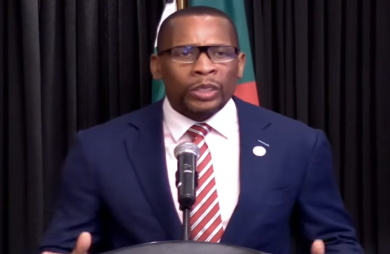
ROSEAU, Dominica, Jul 10, CMC – Governor of the Eastern Caribbean Central Bank (ECCB), Timothy Antoine, says the financial institution must move from safeguarding monetary and financial stability to building macro-financial resilience.
“At its core, macro-financial resilience poses a simple but profound question. Can our economies absorb shocks, recover quickly, and emerge stronger- what I like to call bouncing forward, not back, forward,” Antoine told a ceremony to mark the change in chairmanship of the ECCB Monetary Council here on Thursday night.
The Council is now being led by Dominica’s Finance Minister Dr Irving Mc Intrye, who has taken over from Antigua and Barbuda’s Prime Minister and Minister of Finance, Gaston Browne.
Antoine told the ceremony that in his view, a resilient currency union rests on five mutually reinforcing pillars, namely monetary stability anchored by a strong Eastern Caribbean dollar and robust foreign reserves, resilient public finances with the objective of not simply reducing debt below the regional target of 60 per cent of gross domestic product (GDP) but building fiscal space to respond to future shocks.
He also said that the framework should allow for a resilient financial system that is strong and well-capitalised and capable of supporting households and businesses in times of stress.
“It also requires insurers or insurance companies to maintain adequate reinsurance so that they can meet policy obligations after major disasters,” Antoine said, adding that the framework should also allow for structural economic resilience achieved by “removing structural vulnerabilities that undermine our ability to absorb shocks while making investments that transform productivity, competitiveness, and long-term growth”.
He said that the fifth pillar is that of climate resilience: “adaptation of our infrastructure to protect our investments and appropriate disaster risk financing with a determined effort to close the financial protection gap”.
Antoine said told the audience which includes finance ministers from the sub-regional Eastern Caribbean Currency Union (ECCU) that of the five pillars, he wanted to highlight two, namely the resilient public finances and structured economic resilience, “aka the big push, because it is my considered view that the Central Bank ought to sharpen its policy focus and its work on these pillars, working very closely with our member countries and development partners.
“No currency union can be truly resilient if resilience depends solely on its central bank. We therefore need a regional fiscal resilience framework that includes stronger fiscal rules, coordinated debt management, disaster contingency financing, macro fiscal early warning systems, and common resilience indicators.”
The Central Bank governor said that these measures will help ensure that member governments are better prepared for future shocks while safeguarding the stability of the ECCU.
“This is where the big push becomes essential. It is a strategy for expanding productivity, productive capacity, improving competitiveness, and reducing structural vulnerabilities. And there are seven pillars to the big push,” he said, urging everyone in the sub-region to get behind the new initiative.
Among the seven pillars are food and nutrition security and energy resilience, with Antoine praising Dominica for the construction of its 10-megawatt geothermal plant.
“You have demonstrated what is possible. Your success is inspiring others in the region,” he said, noting that several prime ministers and senior colleagues visited the geothermal plant on Thursday.
“Today they represent a strategy to reduce structural vulnerabilities while creating new engines of growth,” he said, noting that the resilient renewable energy infrastructure investment facility.
“This platform, approved by the Monetary Council, is being operationalised with an initial value of US$235 million or EC634.5 million. It is a result of a collaboration with the ECCB and the World Bank aimed at accelerating our region’s renewables.
“This initiative will unlock private investment in renewable energy while reducing energy costs and strengthening energy security. It is precisely the type of capital investment required to build long-term resilience, and this is one of the flagship projects of the big push.
“Another example is the CARICOM (Caribbean Community) payment and settlement system. The ECCB is currently participating in a pilot with three other central banks to develop a real-time, low-cost, cross-border payment system in local currencies with CARICOM,” Antoine said, noting that “if successful, this system will deliver fast regional payments, lower transaction costs, deepen regional trade, and stronger financial integration.
“The partial credit guarantee programme. Our banking system has almost EC30 billion in deposits but a little less than EC17.17 billion in loans. Meanwhile, our small businesses continue to struggle to access credit.
“This initiative seeks to bridge that gap. Already over 300 guarantees have been issued to a value of EC32 million, and we now want to scale that up by sharing the risk with participating financial institutions, banks, credit unions, development banks.”
Antoine said that the programme is intended to unlock credit for businesses that would otherwise struggle to obtain finance.
“As you know, the guarantee is 75-80 per cent. So if you borrow EC$100,000, the guarantee would be for EC$75,000 or EC$80,000.What that does is to reduce the risk to the financial institution and make it easier for them to make the loan.
“It’s also going to be a lower rate because of the guarantee that is backing the loan. We really have to move on this programme,” he said, noting that another initiative, the STEM camp, launched three years ago, is designed to train 500 students between the ages of 13 and 18 in generative AI and Python each summer.
“This year’s camp will commence on Monday, July 13, and will run for one month. Our students will move beyond using generative AI to become creators, innovators, and problem solvers ready to lead the digital future of the Eastern Caribbean Currency Union.
Meanwhile, as he accepted the chairmanship of the Council, McIntyre was doing so with an “unwavering commitment to regional cooperation” to help safeguard the financial well-being of more than 650,000 people across the currency union.
“From Anguilla in the north to Grenada in the south, I therefore assume this responsibility with a profound sense of duty, fully mindful of the uncertainty created by an increasingly volatile geopolitical and economic environment.
“Yet, even amid these uncertainties, our resolve remains firm. Together, we will continue to safeguard monetary and financial stability while accelerating the transformation of our economies to deliver sustainable, inclusive, and shared prosperity for all our people.
“Today’s global environment presents significant challenges to our transformation agenda. Against this backdrop, economic growth across the ECCU is projected to average just under three per cent in both 2026 and 2027, well below the seven per cent growth needed to achieve the ambitions of our Big Push,” McIntyre said, adding, “This reality demands purposeful and coordinated action.
In his address, Prime Minister Browne called for a new era of bold regional action to transform the economies of the ECCU into greater prosperity, expanded ownership opportunities and sustainable wealth creation for the people of the Eastern Caribbean.
Browne said the ECCU had successfully navigated a period marked by geopolitical uncertainty, inflationary pressures, volatile energy markets and shifting global trade dynamics while preserving macroeconomic stability and strengthening the foundations for future growth. “I am pleased to report that, through sound leadership, prudent policy and unwavering regional cooperation, our Currency Union has remained stable, resilient and well-positioned for future growth,” Browne said.
He noted that despite significant global headwinds, the economies of the sub-regional grouping had demonstrated remarkable resilience, recording estimated economic growth of 3.3 per cent during 2025, and that despite these achievements, regional leaders must now focus on translating economic resilience into lasting prosperity.
“Our challenge now is to transform that resilience into greater prosperity, stronger institutions and expanded opportunities, including ownership and earning opportunities for our people. Our people must be positioned to control the commanding heights of the economies of our respective countries,” he said.
He said that one of the Eastern Caribbean’s most significant monetary achievements has been the 50th anniversary of the fixed exchange rate of EC$2.70 to US$1.00, which he described as one of the world’s most enduring and successful monetary arrangements.
CMC/cj/ir2026