
By Peter Richards
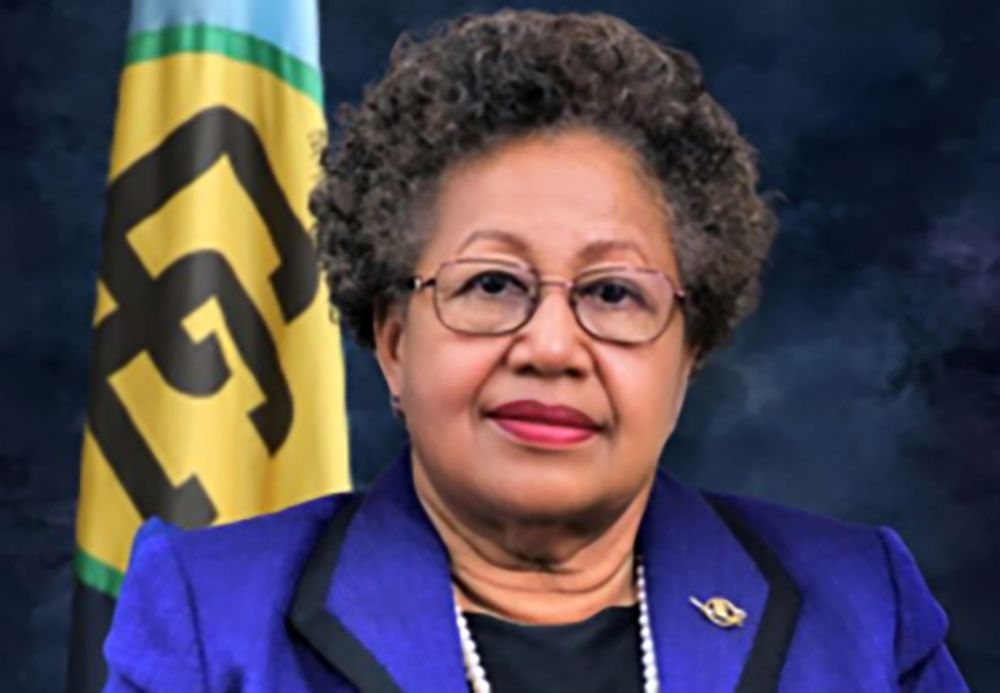
BRIDGETOWN, Barbados, Jun 24, CMC – Less than two weeks before Caribbean Community (CARICOM) leaders gather in St. Lucia for their summit, a legal opinion has surfaced laying doubts as to the correctness regarding the re-appointment of Dr. Carla Barnett as the grouping’s secretary general.
CARICOM leaders meet in St. Lucia from July 5-8.
In March, in a brief statement, the CARICOM chairman and St Kitts and Nevis Prime Minister, Dr Terrance Drew, said that Barnett had attained the “required majority” from among regional leaders regarding her re-appointment at February’s CARICOM summit held in Basseterre.
Barnett had become the eighth CARICOM Secretary General on August 15, 2021, and her re-appointment was made during the leaders’ retreat in Nevis in February this year.
But Prime Minister Kamla Persad-Bissessar, who was not present at the retreat, says Trinidad and Tobago will not recognise the Belizean-born economist after August, when her first five-year term ends.
“Trinidad and Tobago only recognises Barnett as SG until the end of her term this August 2026. All CARICOM leaders could do as they please, but Trinidad and Tobago will not recognise her as SG for the next term. That’s not going to change,” Persad-Bissessar said, adding, “We have already made that clear. We do not recognise her after August 2026. This is our final position,” she added.
Jamaica’s Prime Minister, Dr Andrew Holness, subsequently called for a meeting of regional heads to resolve the matter.
“I think the solution really lies in assembling another heads meeting to have the matter addressed,” Holness told the Trinidad Guardian newspaper.
In May, Dominica’s Prime Minister Roosevelt Skerrit, said as far as he is concerned, the Belizean economist has been reappointed, and that Dominica had supported the decision.
“The issue of the Secretary-General has been, and, I’m not sure why you asked me the question, but this thing has been ventilated in the public domain. I mean, every plate and spoon in the kitchen has been exposed to this matter,” Skerrit added.
Now, in a 48-page paper, Professor of Commercial and Environmental Law at the St. Augustine campus of the University of the West Indies (UWI), Rajendra Ramlogan, is arguing that the reappointment of Barnett was procedurally flawed and legally void.
Ramlogan, who said he was approached by a “regional expert to provide an independent legal opinion on the matter,” said the re-appointment raises questions that extend well beyond the tenure of a single office holder.
“At issue is whether the constitutional architecture established under the Revised Treaty of Chaguaramas (which governs the regional integration grouping) continues to operate as a binding legal framework, or whether procedural flexibility may displace treaty discipline when institutional convenience is attractive,” Ramlogan argued in his paper, a copy of which has been obtained by the Caribbean Media Corporation (CMC).
“This opinion proceeds from the proposition that regional integration derives legitimacy not merely from political consensus but from visible fidelity to agreed constitutional processes,” wrote Ramlogan, noting also that he had undertaken the assignment on a “ pro bono basis in the interest of contributing to informed public and regional discourse”.
He said that his opinion identifies several interlocking procedural and constitutional concerns which, when considered cumulatively, establish a substantial legal basis for questioning the validity of the reappointment process.
“The first and most fundamental concern is one of institutional competence. Article 24 of the Revised Treaty confers the authority to appoint and re-appoint the Secretary-General specifically upon the Conference of Heads of Government.
“The legal question is therefore not whether Heads of Government discussed the issue, but whether they acted through the institutional form prescribed by the Revised Treaty. The evidence examined raises a substantial argument that the decision emerged from a Retreat operating under procedures materially different from those governing Meetings of the Conference.”
Ramlogan argued that if the body exercising authority “was not legally functioning as the Conference, the issue becomes one not of procedural imperfection but of competence itself”.
He said that concern is strengthened by the treatment of representation rights.
“Article 11(2) of the Revised Treaty provides that any Head of Government may designate a Minister or other representative to attend any Meeting of the Conference. The language is broad and unqualified. It reflects a deliberate constitutional choice that Member States act institutionally rather than personally.
“The Rules of Procedure revised in February 2023 reinforce rather than diminish this structure. Although the Rules permit Heads-only caucus arrangements for deliberative purposes, they expressly preserve participation rights where decisions are taken. Read together, the Treaty and the Rules suggest that the exclusion of designated representatives cannot coexist with the exercise of the Conference’s formal powers,” Ramlogan wrote.
He said that the second major issue concerns the role of the Community Council. Article 24 of the Revised Treaty establishes that the appointment of the Secretary-General occurs by the Conference on the recommendation of the Council.
“This opinion concludes that reappointment is part of the same constitutional appointment architecture rather than a separate, unconstrained process. Re-appointment is not administrative continuity but the conferral of renewed constitutional authority following expiry of a fixed term. Absent express language excluding Council involvement upon renewal, the better interpretation is that the recommendation requirement remains operative.”
Ramlogan said that he hopes his opinion will assist in the ongoing discussion surrounding these issues and contribute meaningfully to wider reflection on governance, institutional legitimacy, and the rule of law within the regional integration movement. The third question concerns voting.
He said that Article 28 of the Revised Treaty establishes the Conference’s ordinary decision-making framework by requiring affirmative support from all members, subject to limited saving provisions regarding abstentions.
“The Treaty does not appear to authorise the transformation of non-attendance or exclusion into a mechanism for achieving voting sufficiency. Because voting thresholds are calculated by reference to membership rather than attendance alone, procedural arrangements affecting participation acquire constitutional significance.”
Ramlogan said particular concern arises from the factual circumstances surrounding Trinidad and Tobago’s participation.
“The evidence examined suggests that representations were initially made, indicating that ministerial participation could occur, but were later altered by a communication limiting attendance to Heads only.
“The omission of this communication from subsequent official explanations raises constitutional concerns. If participation rights guaranteed under Article 11 of the Revised Treaty were restricted in circumstances affecting a vote, the issue extends beyond procedural defect into questions of institutional fairness and good faith.”
He said additional concerns arise from broader principles of good administration.
“These include the absence of an express agenda item dedicated to reappointment, the active administrative involvement of the Secretary-General in communications surrounding participation arrangements, uncertainty concerning plenary confirmation procedures, and the absence of any visible legal roadmap from the Office of General Counsel.
“Individually, these issues may not determine legality. Collectively, they raise questions concerning transparency, impartiality, and procedural regularity.”
Ramlogan said that these issues must be viewed against the historical development of Caribbean integration.
He said that the Revised Treaty emerged from the lessons of the collapse of the West Indian Federation and reflected a deliberate movement away from political accommodation toward constitutional governance.
“CARICOM’s institutions, procedures, and voting rules were not designed as technical formalities but as safeguards preserving sovereign equality while enabling integration.
“That historical lesson remains decisive. Regional integration advances not when difficult decisions are made quickly, but when difficult decisions are made lawfully. If the Revised Treaty can be set aside with respect to the appointment of CARICOM’S chief administrative officer, then the constitutional guarantees protecting both smaller and larger states alike become contingent rather than binding.
“Yet if the Revised 5 Treaty is applied faithfully, even where inconvenient, CARICOM affirms the principle upon which enduring regional unity depends, that no office, no political objective, and no institutional preference stands above the constitutional order created collectively by Member States.
“The continuing forward march toward Caribbean unity requires not less law but more fidelity to it,” Ramlogan argued in his paper.
CMC/pr/ir/2026