



By Staff Writer
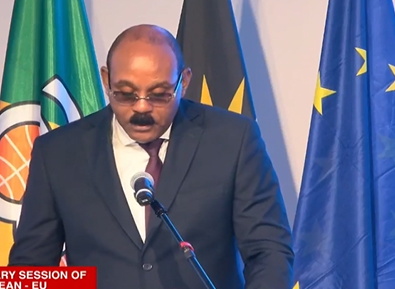
ST. JOHN’S, Antigua, Jun. 21, CMC — Incoming Chairman of the Organization of Eastern Caribbean States (OECS), Prime Minister Gaston Browne, has called for bold action to strengthen regional integration, including the creation of a dedicated OECS airline, deeper economic cooperation, and renewed engagement with the United States.
Addressing the opening of the OECS Authority meeting as he assumed the chairmanship for the next 12 months, Browne said the sub-regional bloc must adapt to a rapidly changing global environment marked by geopolitical tensions, rising living costs, supply chain disruptions, and shifting international alliances.
“The world that we live in today is significantly different from the one 45 years ago,” he said, arguing that small island states must deepen cooperation to protect their interests and remain relevant in an increasingly fragmented world.
A central feature of the Prime Minister’s vision is the establishment of a dedicated OECS airline to improve transportation links across the Eastern Caribbean and support trade and tourism.
He revealed that discussions are underway on a proposal that would utilize approximately US$50 million in unclaimed deposits held within the Eastern Caribbean banking system, along with potential support from European Union funding mechanisms, to launch the airline.
“A region that cannot move its people efficiently and effectively cannot integrate commercially,” Browne said.
He urged regional leaders to push ahead despite resistance from some government officials, arguing that previous generations had created enduring institutions such as the Eastern Caribbean Central Bank and the Eastern Caribbean Civil Aviation Authority.
“Our forebears made decisions and created institutions that are sustaining. Why can’t we, in the 21st century, with far more resources, establish a sustaining airline for the benefit of OECS people and the Caribbean region in general?” he asked.
Browne said improved air connectivity would not only strengthen commerce and tourism within the OECS but could serve as a model for wider Caribbean integration.
The Antiguan leader also addressed recent U.S. immigration and travel policies affecting Caribbean nationals, calling for a reconsideration of restrictions that he said could damage long-standing economic and people-to-people ties.
While acknowledging the United States’ sovereign right to determine its border security policies, Browne urged Washington to take into account the historically close relationship between the Caribbean and the United States.
“We are beneficial partners for the American economy, not adversaries to be restricted,” he said.
Browne noted that OECS nationals regularly travel to the United States for business, education, family visits, and tourism, while Caribbean consumers purchase American goods and services and contribute significantly to the U.S. economy.
He argued that restrictions on travel ultimately hurt both sides by reducing commercial activity and weakening family and cultural connections, particularly given the large Caribbean diaspora living in the United States.
At the same time, he emphasized the region’s commitment to cooperation with the United States on security matters, including combating drug trafficking and organized crime.
“We share the United States’ commitment to security, to the rule of law, and transparent governance,” he said, adding that stronger trade, travel, and people-to-people links would benefit both regions.
Browne also raised concerns about U.S. requests for Caribbean countries to accept third-country deportees, saying Antigua and Barbuda had resisted proposals that could place undue burdens on small island states.
He disclosed that Antigua and Barbuda had proposed accepting no more than 10 deportees annually and stressed that the country would not accept individuals with serious criminal backgrounds.
“We want to be cooperative, but we must protect our country and our people,” he said.
The incoming chairman urged OECS countries to strengthen economic ties with Latin America, arguing that the region has not fully capitalized on opportunities presented by its Spanish-speaking neighbours.
He pointed to Central America and Panama as potential partners for food security initiatives and supply chain diversification, noting that Caribbean countries import the vast majority of the food they consume.
Browne suggested that stronger sourcing partnerships and the use of Panama as a regional logistics hub could help reduce food costs and improve resilience against external shocks.
The Antiguan prime minister also called for greater regional collaboration on renewable energy projects, particularly geothermal development.
He revealed that Antigua and Barbuda has been exploring opportunities to invest in geothermal energy projects in neighboring islands, including St. Kitts and Nevis, with a long-term vision of supplying clean energy across the sub-region through interconnected infrastructure.
Such investments, he said, would reduce dependence on imported fossil fuels, lower electricity costs, and improve regional competitiveness.
Browne further urged OECS countries to place greater emphasis on the blue economy, noting that the sub-region controls approximately 500,000 square kilometres of ocean space.
“We are not necessarily small island developing states. We are large ocean states,” he said.
He called for the OECS Commission to develop a regional blue economy investment portfolio within six months, identifying bankable projects that could attract public and private investment.
He also announced plans to seek reforms within the OECS Commission itself, calling for a leaner, faster, and more effective institution capable of delivering better results for citizens.
He said he had already discussed the matter with OECS Director General Didacus Jules and would be requesting a formal reform plan aimed at reducing costs and improving service delivery.
Reflecting on the OECS’s 45th anniversary, the incoming chairman said the organization had demonstrated that shared institutions can work and remain critical to the survival and prosperity of small states.
“When we deepen integration, we are not surrendering sovereignty; we are actually pooling it,” he said.
He urged regional leaders to embrace ambitious solutions and collective action, saying unity offered the best path toward resilience, economic growth, and greater influence on the global stage.
“In unity there is not just strength,” Browne said. “There is relevance, leverage, and the capacity to shape our destiny rather than have it shaped for us by larger external forces.”
CMC/ab/kb/2026