
By Staff Writer
ROSEAU, Dominica, Aug 4, CMC – The Dominica government Tuesday presented an EC$1.15 billion (One EC dollar = US$ 0.37) national budget to Parliament, reducing or removing several tax measures which it said would cost the Treasury an estimated EC$43.5 million annually.
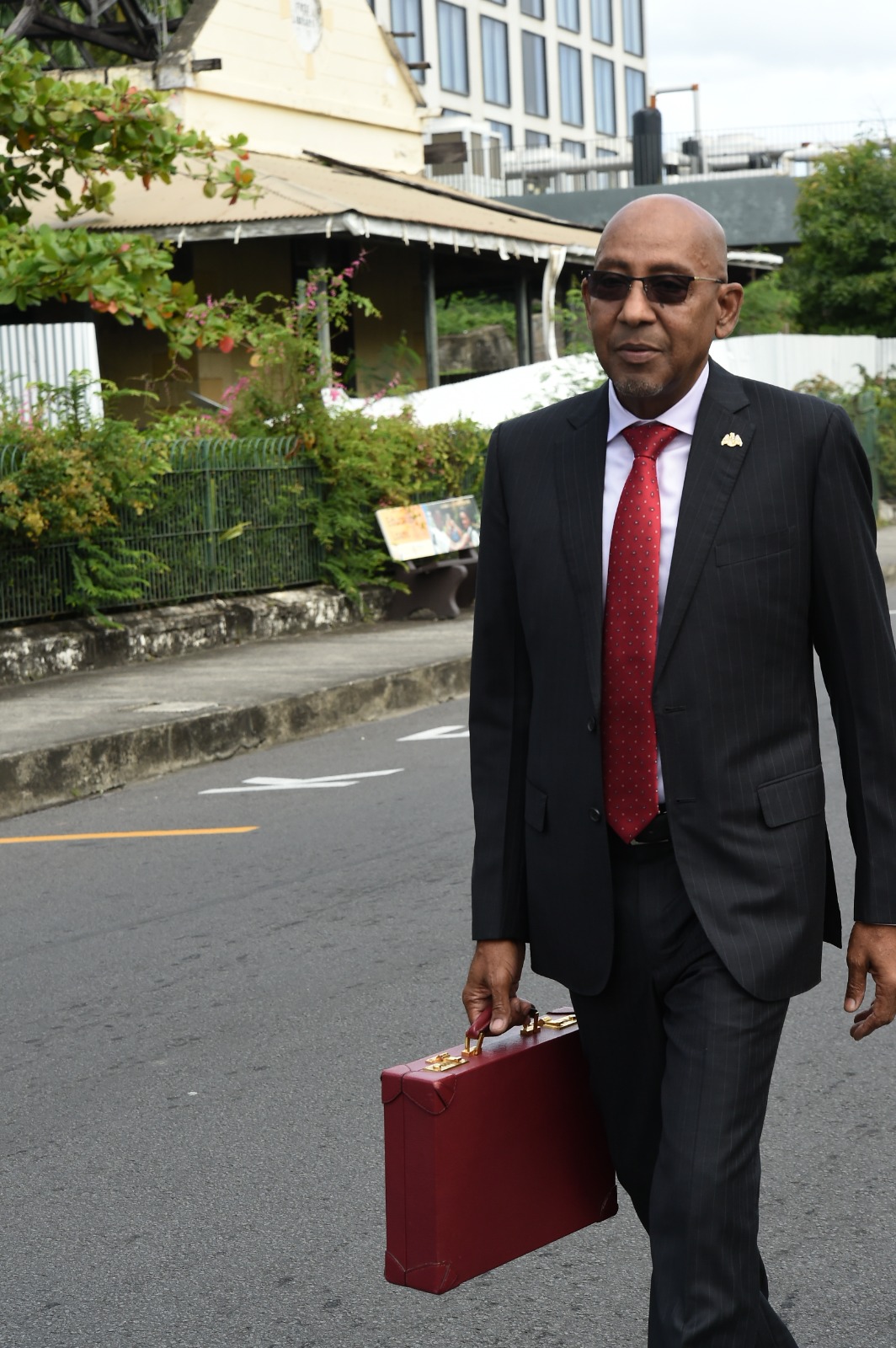
“This Budget has been prepared in that spirit, not fear, but foresight; not retreat, but readiness; not surrender to uncertainty, but a decision to give Dominican households, workers and businesses greater control over their future,” Finance Minister Dr. Irving McIntyre said in his more than two-hour delivery of the fiscal package.
“This budget is a covenant. A covenant between this government and the people of Dominica. A promise that even in a world of rising costs, climate shocks and global uncertainty, we will not waver in our duty to protect, to invest and to build,” he added.
The budget debate begins on Thursday.
McIntyre said that the International Monetary Fund (IMF) is projecting that Dominica’s economy will expand by a further 3.1 per cent in 2026, that is, 0.1 per cent above the three per cent forecasted for global and Eastern Caribbean Currency Union (ECCU) economies. He said inflation is projected to average three per cent before easing towards its long-term norm of 2.2 per cent by 2028.
According to McIntyre, the Roosevelt Skerrit government anticipates tax revenues of EC$473.53 million, non-tax revenue of EC$558.57 million, with total recurrent revenue put at EC$1,032.10 million.
Capital revenue is estimated at EC$10 million and grants at EC$117.55million for a total revenue package of EC$1,159.65 million
“Government intends to use continued growth, stronger revenue and greater public service efficiency to improve the fiscal position, raise disposable income and reduce business costs.”
McIntyre said from 2026/2027, the government commits to an annual primary surplus of at least two per cent of gross domestic product (GDP) until the debt-to-GDP ratio declines to 60 per cent, noting that the current estimates project a surplus of 2.2 per cent.
“That discipline preserves room to maintain essential services and respond to future shocks.,
he said, adding that the government is proposing a total recurrent expenditure of EC$675.1 million for the fiscal year.
He said it covers legally mandated expenditure and those required for the day-to-day operation of the state, including payment of public-service salaries, utilities, and rent, the procurement of supplies and equipment, maintaining roads, and operating the education, health, national security and justice systems.
McIntyre told legislators that beginning from the income year 2027, the government will introduce two new allowable tax deductions for businesses: the first is a new capital allowance in respect of the construction and substantial reconstruction of commercial buildings offered for rent; and the second is a deduction for amounts set aside for disaster financing
He said that deduction for new commercial rental buildings owners of qualifying commercial rental properties will be allowed an annual capital allowance equal to the lesser of three per cent of the construction cost or EC$30,000 per year for up to 10 years after the building was constructed or substantially reconstructed. He said this measure will become effective in income year 2027.
McIntyre said that the Business Vulnerability Fund Deduction is necessary given that, as one of the world’s most climate-vulnerable countries, Dominica understands better than most the importance of preparing before disasters strike and has first-hand experience of rebuilding repeatedly after severe weather.
He said for this reason, the government established the Vulnerability Risk and Resilience Fund in 2017 to strengthen the island’s ability to respond quickly to natural disasters and reduce its financial vulnerability.
As at June 30, this year, the Fund stood at EC$28.3 million, with McIntyre saying that several government statutory bodies are also operating similar funds. He said the government now wishes to encourage the private sector to adopt a similar approach.
“Beginning income year 2027, a business that establishes an approved Vulnerability Fund will be allowed an annual income tax deduction equal to the amount contributed to the Fund, up to a maximum of 0.5 per cent of annual gross sales.’
The Finance Minister said that these deductions will continue until the balance of the Fund equals the net book value of the business’s insurable fixed assets.
He said businesses wishing to participate must apply to the Comptroller of Inland Revenue for approval and that withdrawals will require authorisation by the Comptroller, and any funds used for purposes other than disaster recovery, or withdrawn without approval, will become taxable.
“This measure allows approved contributions to a disaster reserve to be deducted in determining taxable income, thereby making it easier for a company to set aside its own resources before a shock rather than depending entirely on emergency assistance afterwards.”
About the employment tax rebate, which the government introduced in 2014 to encourage businesses to create new jobs and expand employment opportunities, McIntyre said that the initiative had two clear objectives, namely to support new and growing businesses and to encourage employers who had been mentoring participants under the National Employment Programme (NEP) to offer them permanent employment.
He said that the rebate was available for one year, from 1st August 2014 to 31st July 2015. “Under the programme, employers were eligible to claim a rebate equivalent to two per cent of the salary paid to each qualifying employee, up to a maximum of EC$600 per employee per year, with an overall cap of EC$6,000 per employer annually.”
He said effective October 1st this year, the government will reintroduce this tax rebate for a period of two years and that the rebate will remain at two per cent of the salary paid to each qualifying employee during the employer’s tax year.
“However, we are increasing the maximum annual rebate from EC$6,000 to EC$10,000 per employer and that a business that creates qualifying new positions can reduce its annual tax liability by up to EC$10,000 for each of the two years, helping to offset the early cost of expanding its workforce.”
The government has also announced an income tax relief, with the Finance Minister saying that this Government has been consistently reducing the income tax burden on working Dominicans.
He said when the ruling Dominica Labour Party (DLP) assumed office in 2000, the income tax structure comprised rates of 20 per cent, 30 per cent and 40 per cent, with a tax-free threshold of just $12,000
But he said following the country’s economic recovery and its successful completion of the IMF-supported programme, from 2009, the government began providing meaningful income tax relief:
“We reduced the tax rates to 15 per cent, 25 per cent and 35 per cent. We also increased the tax-free threshold first to EC$25,000 and then to EC$30,000. We increased mortgage deductions from EC$15,000 on one property to EC$30,000 and EC$15,000 on a first and second property respectively. We allowed deductions for student loans, home and medical insurance.”
McIntyre said that all of these have reduced the income tax burden on workers and removed thousands of Dominicans from the income tax net altogether, thereby allowing families to retain a greater share of their income.
“Today, despite a global environment marked by economic uncertainty, this government will again provide relief to further empower the hardworking people of Dominica. It is therefore my pleasure to propose that effective January 1, 2027, the government will replace the income tax rates of 15 per cent, 25 per cent and 35 per cent with a single, flat rate of 10 per cent.
“This is a sacrifice the Government is making to support the working people in our country. It is the most significant income tax relief ever granted to the people of Dominica. It will deliver meaningful savings to workers and make our tax system simpler and fairer.”
McIntyre said that the removal of income tax on worldwide income will encourage Dominican retirees, remote workers and investors to make Dominica their home, knowing that only income earned in Dominica will be subject to tax.
He said that the government has also undertaken a review of firearm licence fees, taking into account the administrative and regulatory costs of the licensing regime and the need to ensure these fees remain appropriate and reflect current realities. Effective 1st October 2026, the annual fee for a firearm licence will increase to EC$1,000.
The Finance Minister said that last year, the government took decisive action to shield Dominican families from the impact of rising global prices by extending the Value Added Tax (VAT) exemption and import duty waivers on a range of essential goods through 31st July 2026.
He said those measures were introduced in response to persistent global economic uncertainties, including higher shipping costs and supply chain disruptions, all of which continue to place upward pressure on the prices of food and other essential commodities in small, import-dependent economies.
He said many of these external pressures remain and the government therefore believes it is prudent to continue providing this important relief to households.
“I am pleased to announce that the existing VAT exemption and import-duty waivers on the covered essential goods will be extended for a further two months, until 30th September 2026. Importers, wholesalers and retailers are expected to continue to pass this benefit on to consumers.
“Let there be no misunderstanding: a concession granted by the state must not be converted into a larger private profit margin. Relief at the port becomes household relief only when it is reflected fairly in the shelf price. We will closely monitor prices to ensure that the intended savings reach our families.”
McIntrye said that the government is also moving to end tax compounding on imports, telling legislators that for many years citizens and businesses alike have expressed concern about the administrative burdens associated with importing goods and the complexity of Customs calculations.
He said these concerns deserve careful attention and that an efficient clearance system should facilitate commerce, not frustrate it.
As a result, he said, the government is committed to modernising the clearance system at the ports of entry and reducing costs and delays, noting that this forms part of a broader strategy to improve the overall ease and cost of doing business in Dominica.
“Every unnecessary delay, duplicated document and avoidable storage or administrative cost is eventually reflected in the price paid by a consumer. Modernising the clearance system is therefore a priority.”
He said that the government has examined the tax structure applied to imported goods and has decided to make some adjustments. At present, Excise Tax and VAT on imported goods are calculated not only on the cost, insurance and freight value—the CIF value—but also on other charges and taxes, including the Customs service charge, environmental surcharge or levy, import duty and Excise Tax.
“Put simply, one tax or charge is added to the base on which another tax is calculated. That is tax compounding. Effective 1st October 2026, Government will end this practice. Excise Tax and VAT will instead be calculated solely on the CIF value of imported goods.
“This measure is a practical example of Government reviewing its own systems. Government also has a clear expectation: where relief is granted, it must be passed on to the consumer,” McIntyre said, noting that taken together, the measures, including the insurance for farmers which was mentioned earlier, form a connected household package. Income-tax flat rate leaves more earnings with workers every month.
He said VAT and import duty relief temporarily shield covered essentials, while the end of tax compounding permanently removes the cost of imports.
CMC/cj/ir/2026