



By Staff Writer
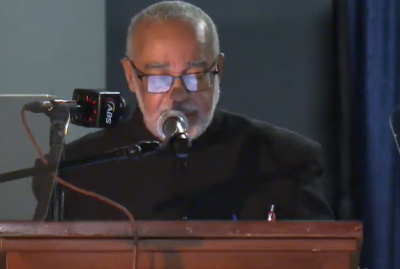
ST. JOHN’S, Antigua, Jun 22, CMC – The Director General of the Organisation of Eastern Caribbean States (OECS), Dr. Didacus Jules, has appealed to the sub-regional grouping to maintain the highest level of cooperation, saying it is necessary in a changing global environment.
Jules, addressing the formal opening of the OECS Summit on Sunday night, said 45 years after its establishment, the OECS has been able to fully cooperate in various spheres to the benefit of the population.
“What, in the end, is this thing that we have built? It is tempting to answer in the language of our trade, to point to the revised Treaty of Basseterre, to protocols ratified and councils convened, to the machinery of a Commission.
“But I’ve come to believe that the Treaty and the machinery, indispensable as they are, are not the integration. They are its scaffolding. Integration itself is not treaties on paper, nor the quiet convergence of government bureaucracies. It is something older and more stubborn than any of that.
“It is the culture of cooperation. In the OECS, our people have a name for it. They call it, in Creole, the kudment. In the Anglophone, OECS, the helping hand, the lend a hand, anything similar. The day the whole village lays down its own work to raise one family’s roof, or bring in one farmer’s harvest, in the certain knowledge that when the season turns, the hands will come for them in their turn,” Jules told the ceremony.
The OECS groups the islands of Antigua and Barbuda, Dominica, Grenada, St. Lucia, St. Vincent and the Grenadines, St. Kitts and Nevis, Montserrat, Anguilla, and the British Virgin Islands (BVI).
Jules said that the St. Lucian-born Nobel Laureate understood that “our genius as a people was never in our size or our wealth, but in precisely this, the hoisting of shared burdens and the reaping of a larger harvest from joint labour.
“The OECS, at its truest, is the kudment written large,” Jules said, recounting the achievements of the sub-grouping over the past year and more specifically the past 45 years.
“And I offer these not as trophies, most are unfinished, but I offer them as consequential evidence that the Kudment works, that joined hands raise a higher roof than any of us could raise alone. And we will need that higher roof because the weather has changed.
“For most of our life as an organisation, we sheltered, however imperfectly, beneath a global order that offered small states some measure of predictable support. That order is passing. It is passing quickly.
“We have entered an age of open contestation among great powers, an age that expects small states to choose sides and to pay for choosing the wrong side. Where assistance long relied upon is withdrawn overnight by the stroke of a distant pen, and the rules we were instructed to honour are bent by the very hands that wrote them.
“We are penalised for our own progress. Some like Antigua and Barbuda and St. Kitts and Nevis are judged too prosperous to be helped by some of the multilateral agencies, even as a single storm can erase a quarter of a nation’s output in an afternoon.
“This is not a season of bad political weather. It is the climate of our era, and we will not talk it away,” Jules said.
He told the audience that the founders of the Caribbean left a warning, and the world has now given its proof.
He said that at the impending demise of the West Indies Federation, the then Trinidad and Tobago prime minister, Dr. Eric Williams, warned that one in 10 leaves “zero (and) that to subtract a single member is not merely to make us smaller, but to imperil the whole.
“They understood that we are not a stack of separate units to be added and removed at will. We are a single fabric, and a fabric does not survive the steady pulling of its threads. The wisdom of that lesson is in danger of being lost in our wider Caribbean region.
“The arithmetic of the geopolitical moment must now teach us the other half of that lesson, that one plus two, properly joined, do not make three. They make up the 12-member states of the OECS. Pooling is not addition, it is multiplication, and 12 twigs bundled together are not so easily broken as one twig snapped at a time. ”
“That is the whole case for our union in a simple image. Alone, each of us breaks. Bundled, we hold. Let us be clear then about what pool sovereignty is, and what it is not, because the concept has sometimes been misinterpreted to suggest the loss of political self-direction.”
Jules said pool sovereignty is not the weakening of political choice. It is not the seeding of it. It is the opposite.
“It is the act of drawing together the boundaries within which we can win the right to exercise the same choices that larger nations take for granted, to enjoy the same freedoms, to command the same herring.
“We pool not to become less ourselves, but to become large enough to remain ourselves in a world that respects only scale. For let no one in this region ever forget it, we are no children of a lesser God. That is why we must insist on measuring pooling by what it returns to our people.
“It must give them a voice, real mechanisms of representation and participation, and not the mere appearance of them. It must give them strength, empowering legislation and enabling civic institutions, our creative sector, our information technology and digital industries, our differently abled, our young people, and the women of our islands, who carry so much of the work and deserve their full share of its rewards.”
Jules said that in the years ahead, if integration is a culture of cooperation, then the central task is no longer only to build institutions.
“It is to make that culture come alive, to carry integration off the conference table and into the daily life of our people. In other words, regional integration has become increasingly inclusive. That begins with deeper political inclusion, a process that we initiated about three years ago, that attempts to bring the parliamentary opposition across the OECS, not to discuss their domestic politics, but to provide technical updates on the work being done in keeping with the revised Treaty of Basseterre”.
Jules said that, as presumed governments in waiting, they must be kept informed on the regional integration initiative, noting that the change of government in at least two of the OECS member states has validated the importance of this inclusion effort to ensure that the integration effort survives every honest turn of the democratic wheel.
He said inclusive integration means opening real avenues for civil society, drawing the private sector, cultural workers, youth, women’s movements, and the differently abled into the rooms where the regional future is decided, rather than informing them of it once it is settled.
“And it means making integration something our people can see and touch. Consider our regional education census, which reaches directly to students, to teachers, to parents. That is integration our people can feel, not an abstraction debated in a distant chamber, but a thing they are counted in, consulted on, and have a hand in building.
“We need a great deal more of it. This is how we turn voice into action. The instruments of pooling must now be placed deliberately at the service of those who will build the economy of our future,” Jules added.
CMC/jh/ir/2026