
By Staff Writer
SANTO DOMINGO, Dominican Republic, Jun 8, CMC- A new report is warning that the future quality of Caribbean democracies will depend on the region’s ability to integrate economic resilience, climate change adaptation, and social cohesion into an institutional framework capable of protecting human development in an increasingly uncertain global environment.
At the same time, the report has also noted that Caribbean democracies face a convergence of structural pressures that simultaneously strain their economic stability, social cohesion, and capacities.
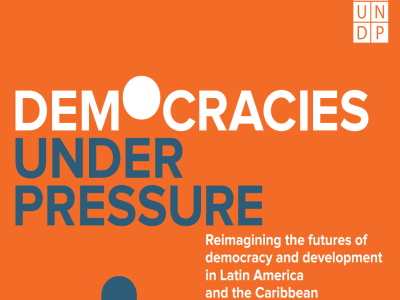
The United Nations Development Programme (UNDP) on Monday launched its report ”Democracies Under Pressure: Reimagining the Futures of Democracy and Development in Latin America and the Caribbean”.
It said Latin America and the Caribbean (LAC) is today the most democratic region among developing regions and the third worldwide, and that more than four out of five citizens live under regimes elected through elections.
“However, this strength coexists with growing tension: democracies that endure, but face pressures that threaten their ability to represent, manage conflict, and generate development outcomes.
“Long-standing structural challenges, such as economic and gender inequality and the crisis of political parties, are now combined with emerging threats: polarization, misinformation, the acceleration of technology, the climate crisis, and the expansion of organized crime. Together, these factors erode institutional trust and weaken the link between democracy and citizens’ well-being.”
With respect to the Caribbean, the report notes that beyond challenges shared across the region, the Caribbean exhibits distinctive characteristics rooted in its colonial history, including the predominance of Westminster-style institutional arrangements, including parliamentary and semi-parliamentary systems, as well as persistent structural vulnerabilities.
“Caribbean democracies face a convergence of structural pressures that simultaneously strain their economic stability, social cohesion, and capacities. Small and highly open economies, heavy dependence on sectors such as tourism, fiscal constraints, high levels of public debt, recurring exposure to natural disasters, and growing security challenges generate constant pressure on State capacities and institutional legitimacy.”
The report notes that each shock–whether climatic, economic, or security related–affects human development and puts democratic resilience to the test.
“In most of the Caribbean, however, electoral democracy remains stable, preserving its institutional continuity, procedural soundness, and consolidated international legitimacy. The region is not facing a widespread erosion of electoral democracy.
“On the contrary, it has been recognized as a bastion of representative democracy, underpinned by respect for the rule of law and strong institutional traditions,” the report states, noting that “these characteristics are reflected in consistently high performance on the core dimensions of the V-Dem Electoral Democracy Index, including free and fair elections, elected officials, inclusive suffrage, and freedoms of association and expression.”
The report noted that this institutional strength is also expressed in comparatively lower levels of political polarization than those observed in Latin American countries.
“Nevertheless, sustaining democracy in the Caribbean will require strengthening State capacity, improving security governance, and consolidating mechanisms of transparency, participation, and accountability.”
The UNDP report notes that while these challenges also affect Latin America, they unfold in the Caribbean under tighter fiscal constraints and greater vulnerability to external shocks.
“The future quality of Caribbean democracies will therefore depend on the region’s ability to integrate economic resilience, climate change adaptation, and social cohesion into an institutional framework capable of protecting human development in an increasingly uncertain global environment.
“This task is conditioned by the unique characteristics of the Caribbean: small-scale economies, high levels of indebtedness, acute climate vulnerability, and the profound influence of transnational migration and security dynamics all generate governance challenges distinct from those experienced in Latin America.
The 323-page report notes that democracy in LAC has demonstrated a remarkable capacity for endurance, yet faces mounting pressures that affect both its functioning and legitimacy.
“The challenge is not only to protect democracy from the risks of erosion, but also to renew it so that it can effectively channel citizens’ demands, manage conflict, and generate human development outcomes in contexts of growing uncertainty. No single actor can offer a comprehensive solution to democracy’s challenges. Responses emerge through the interaction between diverse actors and the construction of agreements in complex settings.”
The report does not present a rigid blueprint; rather, it proposes elements to guide debate and action in contexts characterized by high institutional and political complexity.
According to the UNDP, reimagining democracy involves understanding how its processes interact with State capacity and human development outcomes.
“Democracy cannot be sustained solely on electoral rules; it requires States capable of implementing decisions and producing results that reinforce legitimacy. At the core of these challenges lies a fundamental issue: the unequal distribution of political influence within the democratic system.
“Different forms of power–economic, coercive, informational, or institutional–translate into unequal capacities to shape collective decisions, distorting political competition and limiting democracy’s ability to represent and manage social conflict fairly.”
The UNDP said that the report calls for safeguarding and renewing democracies. It identifies one strategic priority and five critical areas of intervention. While these do not resolve every challenge facing democracy, they focus on key dynamics capable of generating broader systemic effects.
“Rather than pursuing immediate and comprehensive transformations, the objective is to identify areas where strategically targeted actions can drive positive dynamics, break vicious cycles, and contribute to rebuilding the legitimacy of the democratic system.
“At the center of this agenda is the need to preserve the minimum conditions for political competition, particularly in the electoral sphere. Strengthening the autonomy of electoral bodies and rebuilding public trust in electoral processes are essential tasks.
“Free and fair elections are a fundamental pillar of democracy, as is the ability to contain dynamics that jeopardize the peaceful alternation in power or undermine the foundations of the democratic system.”
The report notes that a strong democracy requires arbiters who are independent and are also perceived as such by citizens.
“It is critical, thus, to ensure that electoral authorities act with and are recognized as guarantors of transparency and fairness, even in contexts of polarization and disinformation.
The report reiterates that the future of democracy in LAC will depend on its ability to transform pressure into renewal and promises into results.
“Democracy will prove resilient if it succeeds in reconnecting the legitimacy of democratic processes with meaningful human development outcomes–a democracy capable of channelling demands and conflicts, building collective projects and delivering concrete improvements in people’s lives.
“This balance ultimately rests on the quality of governance. Effective governance–able to anticipate risks, adapt to change, and respond with resilience–is the central enabler of human development, agency, and social legitimacy, and an indispensable condition for sustaining democracy, protecting freedoms and preventing democratic setbacks,” the report noted.
CMC/pr/ir/2026